Twenty-five years after systematic sexual violence during the Kosovo war, the absence of justice reflects a sustained political arrangement, not a failure of evidence.
Klea Ukaj (Michigan, USA)
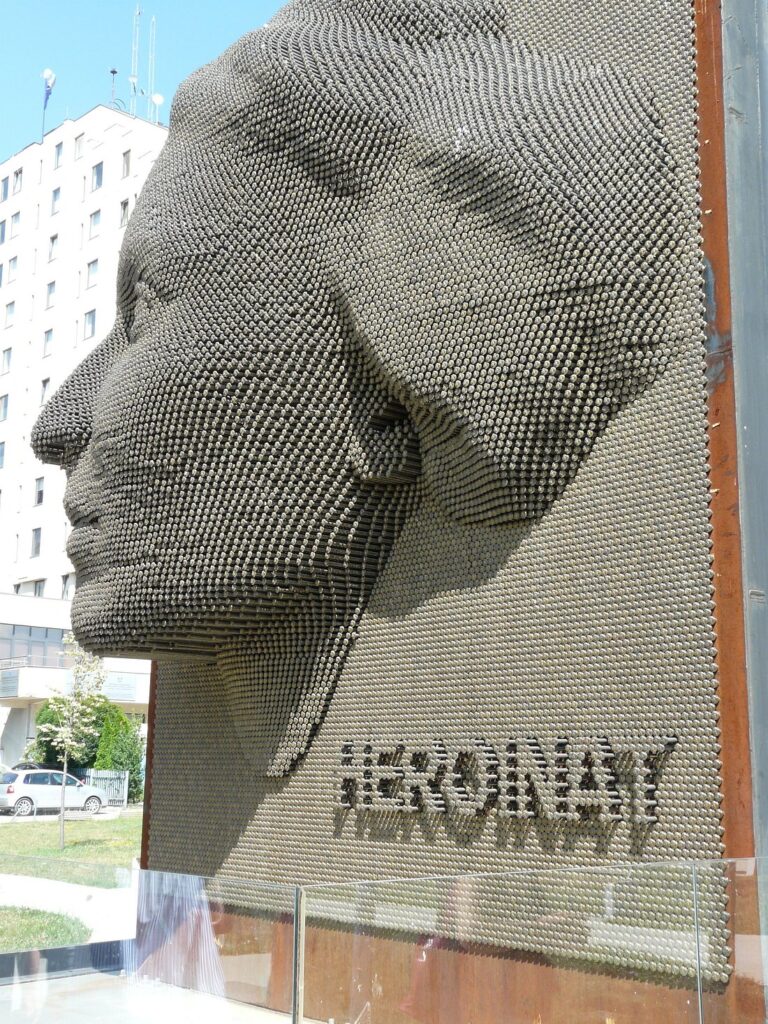
When Kosovo’s Acting President Albulena Haxhiu announced twelve new indictments for wartime sexual violence at the Heroines memorial in Pristina, she was describing real institutional progress. Kosovo’s courts are processing war crimes cases at a pace that would have been unimaginable a decade ago. Three convictions are on record. Five prosecutors are now dedicated to these cases.
It is progress built a quarter century after crimes that affected tens of thousands of people. Every prior mechanism with authority to deliver justice either failed to act or operated under binding constraints. The gap between the evidentiary record and the accountability record in Kosovo is not a puzzle requiring further investigation. It is the predictable output of a political equilibrium that Serbia has sustained and that Kosovo’s international partners have consistently chosen not to disrupt.
Understanding why requires clarity about what that equilibrium is, how it was constructed, and what it would cost to change.
The Record Is Not in Dispute
Estimates of the number of women and girls subjected to sexual violence by Serbian military, police, and paramilitary forces between February 1998 and June 1999 range from 20,000 to 45,000. The Centers for Disease Control and Prevention’s survey of displaced Albanian populations remains the most methodologically grounded assessment. The exact total will never be established because most survivors did not come forward and some were killed after being raped.
What the documentation consistently establishes is that sexual violence was not incidental to Serbian operations in Kosovo. It was integral to them. Human Rights Watch, the OSCE’s Kosovo Verification Mission, and multiple UN bodies documented a pattern of rape and sexual assault embedded in military operations across municipalities and in convoys as civilians were expelled. The ICTY’s own jurisprudence established that these acts occurred within a joint criminal enterprise conducted by forces under the authority of the Federal Republic of Yugoslavia and Serbian state institutions. The evidentiary record is not contested. The absence of justice cannot be explained by uncertainty about what happened or who was responsible.
As time passes, moreover, the evidentiary burden shifts. The question is no longer whether the crimes occurred but whether accountability remains structurally possible. The answer depends less on evidence than on politics.
The Institutions Did Not Fail. They Operated Within Constraints.
The standard account frames Kosovo’s accountability deficit as a cascade of institutional failures: the ICTY did not pursue sexual violence in Kosovo aggressively enough, EULEX underperformed, Kosovo’s domestic courts took too long to develop capacity. This framing, while not inaccurate, obscures a more precise reality. The institutions built to prosecute these crimes did not collapse. They operated within limits defined by political priorities external to them.
The ICTY produced landmark jurisprudence recognizing rape as a crime against humanity, as an act of torture, and as an instrument of ethnic cleansing. It convicted three senior Yugoslav officials for sexual assaults in Kosovo as part of a broader persecution campaign. What it did not produce was a prosecution specifically targeting mass sexual violence against Kosovo Albanian women as a distinct criminal enterprise. This was not an evidentiary gap. It reflected choices about prosecutorial priority within an institution operating under significant political pressure regarding its relationship with Belgrade during a period when Serbian cooperation with the tribunal was itself a diplomatic variable.
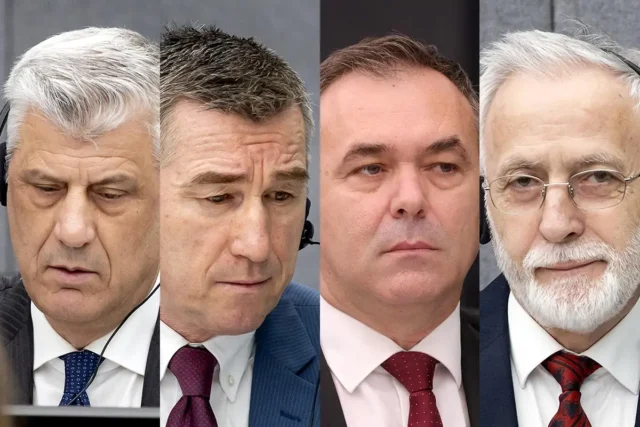
EULEX operated in Kosovo from 2008 with a mandate that included war crimes. Its outcomes on conflict-related sexual violence were limited in proportion to the political sensitivity of the issue rather than its gravity. The Kosovo Specialist Chambers in The Hague, established with international support and funding, has jurisdiction over crimes committed during the Kosovo war. It has not charged a single Serbian perpetrator for sexual violence. These outcomes are not coincidental. They reflect the consistent operation of a system in which accountability for wartime rape in Kosovo was treated as a secondary objective relative to other strategic considerations.
Serbia: The Mechanism, Not Just the Obstacle
The most direct constraint is jurisdictional. Of the one hundred accused in Kosovo war crimes cases ongoing in 2024, ninety-eight were members of Serbian forces. Six of the thirteen indictments filed that year were in absentia, covering suspects who are in Serbia and will not be delivered. Kosovo amended its criminal code in 2019 to enable trials in absentia for wartime offenses precisely because it recognized that normal jurisdictional logic had reached its limit. A legal record without enforcement is recognition, not justice.
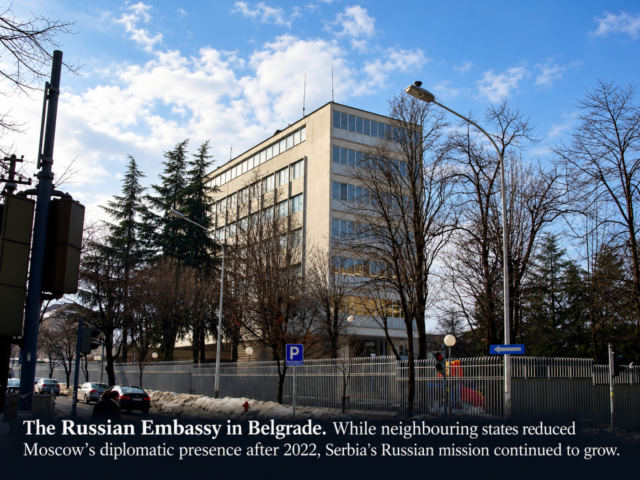
Serbia’s posture on extradition is frequently described as intransigence. The more precise description is strategic consistency. The issue is not Serbia’s capacity to prosecute but the political consequences of doing so. Pursuing the individuals who carried out systematic sexual violence in Kosovo would require Serbia to accept that the crimes were not aberrations but the product of state-directed operations, a conclusion already embedded in ICTY jurisprudence. To act on that conclusion in its own courts would implicate the command and institutional structure that authorized and directed those operations. That is the threshold Belgrade has consistently refused to cross.
The domestic political logic reinforces this position. The Serbian public narrative of the Kosovo war has not incorporated the systematic nature of crimes against Albanian civilians as an acknowledged fact. Accountability proceedings would require Serbian institutions to produce, in open court, evidence confirming what international tribunals have already determined: that the violence was organized, state-sanctioned, and deliberate. Successive Serbian governments have calculated that cost as prohibitive. Serbia’s War Crimes Chamber has processed cases from other conflicts and produced dozens of convictions, almost none involving senior officials, almost none focused on Kosovo. The institution exists in part to demonstrate formal accountability while preserving the political insulation of the most sensitive cases. This is not negligence. It is architecture.
The International Equilibrium
The accountability gap is not Serbia’s creation alone. It is also the outcome that Kosovo’s international partners have consistently chosen not to prevent. This does not require coordination or explicit agreement among them; it reflects a convergence of policy choices across institutions and governments that has produced a predictable result.
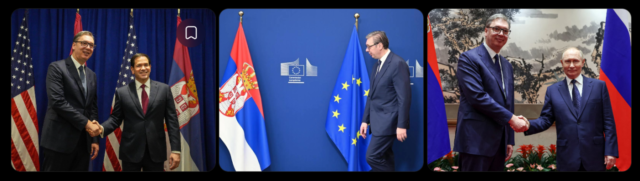
Vasfije Krasniqi Goodman, the first woman to speak publicly about her rape in Kosovo, reported her case to UNMIK in 1999. No outcome followed. She reported it to French KFOR in 2004. No outcome followed. She testified before the United States Congress in 2019. A concurrent resolution in the 119th Congress this year called on Serbia to extradite perpetrators and cease protecting individuals involved in war crimes. In the decades between Goodman’s first report and the most recent congressional resolution, bilateral engagement between the United States, the European Union, and Serbia proceeded through trade negotiations, enlargement frameworks, dialogue facilitation, and strategic partnership discussions. Accountability for wartime sexual violence in Kosovo appeared consistently as a secondary concern.
In practice, accountability was treated as subordinate to regional stability, diplomatic management of Serbia’s trajectory, and broader geopolitical considerations. The EU accession framework, the most powerful structural leverage available to European capitals, has not been deployed to make war crimes cooperation a material condition of progress. The leverage exists. The decision has been made, repeatedly and across administrations, not to use it systematically. That outcome was not inevitable. It was enabled.
What Kosovo Is Building, and What It Cannot Build Alone
Kosovo’s domestic courts are constructing a record that will outlast the current arrangement. Thirty-four war crimes cases involving one hundred accused were ongoing in 2024. The first absentia conviction for crimes in Shtime was delivered in December 2024. A further conviction followed in November 2025. The prosecutorial trajectory has genuine institutional momentum, and survivors are beginning to come forward as the legal environment becomes more capable of receiving their testimony.
None of this can substitute for the cooperation it will not receive from Serbia. Of the estimated 20,000 survivors of wartime sexual violence, fewer than 2,000 had applied for Kosovo’s recognition and compensation commission by 2023. The gap reflects the rational assessment of people who have watched institutions receive testimony for twenty-five years without delivering consequences to those responsible. A monthly pension and a legal record are not substitutes for accountability. They are what accountability looks like when accountability itself has been made structurally unavailable.
The Equilibrium and Its Cost
As long as Serbia faces no material cost for refusing cooperation on war crimes, and as long as international actors continue to subordinate accountability to other strategic priorities, the existing equilibrium will hold. Changing it requires specific action: EU accession conditionality tied to war crimes cooperation, sustained diplomatic pressure that treats this issue as a first-tier concern in bilateral engagement with Belgrade, and a willingness by the Kosovo Specialist Chambers to use its mandate to pursue perpetrators of systematic sexual violence against Kosovo Albanian civilians. None of these mechanisms is unavailable. Each has been assessed, by relevant actors, as carrying costs that exceed the benefits of the accountability they would produce.
That assessment is a choice, renewed every year the equilibrium holds. Its cost is not borne by the governments making it. It is borne by the survivors of Kosovo’s war who have been waiting, with diminishing time, for an outcome that current policy does not make likely.
Kosovo is building a record. Without a deliberate shift in the political conditions that sustain it, that record will remain an archive of impunity rather than an instrument of justice.
Klea Ukaj is a writer and civic commentator based in Michigan. Originally from Tirana, she holds a degree in Banking and is a prominent voice in the Albanian-American community. Her work focuses on Western Balkan and transatlantic affairs.