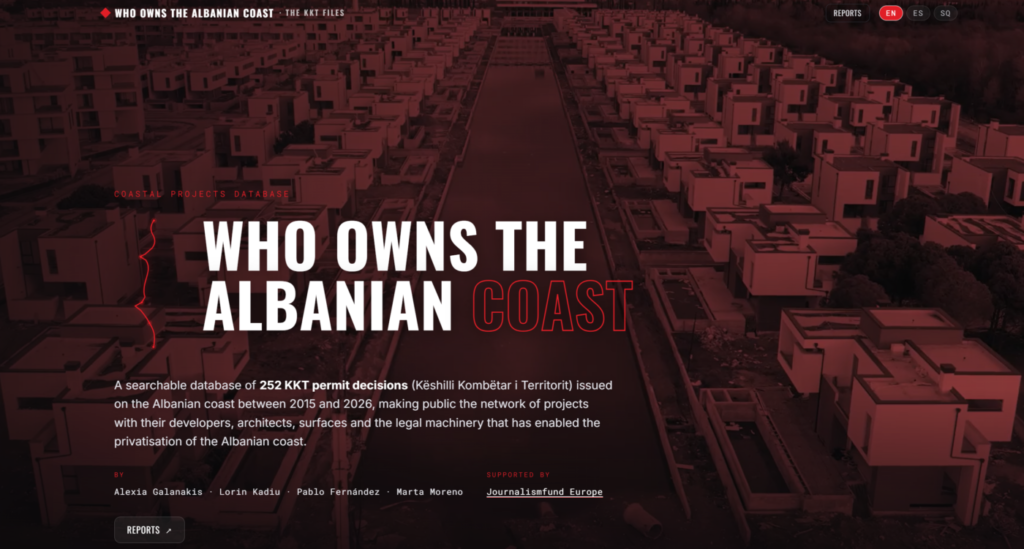
A new database announces that the Albanian state has given away 2.1 million square meters of its coast. The official acts say otherwise. The first number will travel farther than the correction.
By Bekim Besimi (Venice)
Somewhere this month, in London or Frankfurt or Vienna, an analyst is assembling a country memorandum on Albania. The fund employing this analyst has never invested in the Western Balkans. It is considering a first position: a hotel platform, a marina concession, a logistics play on the back of a tourism sector that keeps breaking its own arrival records. The analyst has two days and a search engine. The search engine now returns, near the top, a handsomely built website called Who Owns the Albanian Coast, four bylines, European grant funding, a scrolling map, and a column headed State land given. The column sums to roughly 2.1 million square meters. The analyst does not read Albanian, has never heard of the Komiteti i Investimeve Strategjike, and will never open a single decision on azht.gov.al. The analyst writes one sentence: significant reputational and legal exposure around coastal land allocation, multiple projects reportedly under anti corruption investigation. The committee reads the sentence. Albania drops out of the memo. No one in Tirana will ever know the meeting happened.
That is how a number works once it is loose. It does not persuade anyone of anything. It simply enters the files from which decisions are made, and it stays there, because files are never corrected with the energy with which they are compiled.
So it is worth establishing, with the acts on the table, what the number is.
What the acts say
The database, launched in late July by Alexia Galanakis, Lorin Kadiu, Pablo Fernández and Marta Moreno with the support of Journalismfund Europe, compiles 252 permit decisions of the National Territorial Council between 2015 and 2026. As an archive it is real work, and we will return to what it genuinely contains. The 2.1 million figure, however, comes from a different place. It is the arithmetic sum of surfaces mentioned in the texts of decisions of the Strategic Investments Committee, the KIS, taken under Law 55/2015. And a KIS decision, as the law states and as every Albanian lawyer who has ever touched an investment file knows, approves a status in principle. It constates eligibility, fixes conditions, and transfers nothing. State property in Albania passes to a developer through one instrument only: a decision of the Council of Ministers, published in the Official Gazette.
Run the database’s own list of eleven coastal projects through that filter, as the state’s clarification issued in answer to our questions now does, and the accounting resolves into a ladder. Surfaces mentioned in KIS decision texts: 2,129,042 square meters. Surface transferred by act of the Council of Ministers: 968,669, concentrated in four projects. Of that, 790,000 square meters at the Durrës marina was not leased but contributed as state capital into the development company, a structure with its own questions, to which we will come. Surface leased to developers: 178,669 square meters. Of that, 90,030 at Gjiri i Lalëzit awaits a Council of Ministers decision not yet published. The surface leased under a published act stands at 88,639 square meters.
The remaining projects are paper, and the state’s own document now records, project by project, what the paper is worth: the Delta Falaise status has ended, the Mediterranean Wave status expired with the procedure not expected to continue, the Atara approval carries conditions the investor has not met, and one listed surface of 70,000 square meters was never development land at all but a beach station attached to a project built entirely on private ground.
The column heading says given. At the layer of a published lease, the figure under it is wrong by a factor of roughly twenty four. Count everything transferred by any act, including the equity structure at Durrës, and it is still wrong by more than half. There is no layer of Albanian law at which 2.1 million square meters of state coast has been given to anyone.
What capital hears
Why does this matter beyond the pleasure of a correction? Because of what the number does in the specific market it has entered.
Tourism investment is the most narrative sensitive capital there is. It is long duration, illiquid, and wholly dependent on permits, title, and the goodwill of a state across decades. An investor in sovereign bonds can hedge a bad government. An investor who has poured concrete on a beach cannot. Such capital does not price average risk. It prices tail risk: the possibility of expropriation, of retroactive illegality, of waking up inside someone else’s corruption case. And tail risk is not assessed from primary documents. It is assessed from exactly the artifacts our analyst found: databases, maps, investigation counts, the phrase state land given multiplied by a large number.
The correction never catches the claim. The 2.1 million figure will appear in risk consultancy briefings, in the country annexes of lender compliance reviews, in the background sections of political risk insurance assessments, and, we would expect, in written questions at the European Parliament and in submissions on Chapter 27 of Albania’s accession negotiations. The 88,639 figure will appear in this newspaper and in a government clarification that closes by describing its own numbers as preliminary. Institutional memory is asymmetric by design. That asymmetry is the entire mechanism.
And the deterrence selects. Here is the coldest entry in the ledger, and the one the database’s authors have not considered. A narrative of lawless allocation does not deter connected capital. Investors who operate through political relationships price this kind of risk through those relationships, and proceed. It deters precisely the other kind: the institutional investor with a compliance department, the hotel group answerable to a listed parent, the fund whose mandate forbids exposure to jurisdictions flagged for expropriation narratives. Frighten the rule following capital away from a frontier market and you have not protected the coast. You have reserved it. The likely beneficiaries of the impression this database creates are the very actors its authors believe they are exposing.
What is actually true
None of this acquits the record the database set out to document, and we will not pretend it does. Roughly 97 hectares of state coastal property has passed out of direct state control by administrative act. Seventy nine of them went into the Durrës marina company as a capital contribution, an arrangement the state’s own clarification could not describe without contradicting itself, asserting in one sentence that the state both contributed the land as capital and remains its owner. Those two things cannot simultaneously be true, and the difference between owning seventy nine hectares and owning shares in a company that owns them is not small. The protected areas law was rewritten in 2024 with its operative provisions inserted at committee stage. The strategic investments register that a 2015 decree ordered built was never built. The KKT register itself was unusable until a foreign funded team made it searchable, a service no Albanian institution performed in a decade. SPAK has a registered investigation into coastal administrative decisions taken since 2024. Every one of those facts deserves publication, scrutiny, and consequence.
That is precisely why the inflation is not a technicality. Albania’s coast presents a real bill of particulars, roughly a tenth the size of the one this database presents, and the real bill is serious enough on its own terms. A publication that takes a genuine 18 to 97 hectare question and dresses it as a 210 hectare answer has not strengthened the case for scrutiny. It has attached the genuine case to a figure that collapses on first legal contact, and when that figure falls, the 252 authentic documents beneath it will be discredited along with it. The developers could not have designed a better outcome.
Collateral, or intention
Which brings us to the harder question.
The distinction between an approval in principle and a transfer by act is not esoteric. It appears in the operative text of the decisions the team itself ingested. One of the four authors is Albanian. The site’s own methodology note tells readers to verify every figure against the original acts, which is to say the authors knew where the truth of their central number lived and published the number without visiting it. The design does the rest: a title that asks who owns the coast and thereby asserts that ownership has moved, a subtitle promising the legal machinery behind the projects, network graphs that render appearance in the same public decision as a form of complicity, a curated layer of prosecutorial and civil society allegations that produces, in aggregate, a criminal atmosphere no individual entry states. Every element deniable, every element pulling one direction. The single factual claim the platform makes in its own voice, the land column, is the one that has now failed verification against the acts.
We can prove the effect. We cannot prove the purpose. But we are entitled to name what we fear: that the flight of legitimate capital from the Albanian coast may not be this publication’s accident. It may be its point. A durable, citable, grant funded artifact asserting that a candidate country’s government has given away its coastline, timed to the most delicate stretch of an accession negotiation, is worth a great deal to anyone whose interests are served by Albania remaining poor, unbuilt, and outside. We do not know that such an interest stood behind this database. We observe only that if one had, it would have commissioned exactly this.
There is a version of Who Owns the Albanian Coast that would deserve every reader it finds: the same 252 documents, a column honestly labeled surface mentioned in decision, a second column recording what actually passed and by which act. It would take its builders a few days, and it would be the most useful public instrument ever assembled on Albanian coastal permitting. Whether the next build makes that correction, now that the reconciliation is public, will tell everyone watching which kind of project this is. The documents are real. The number was not. Investors, unfortunately, can only read one of them, and it is not the documents.
Bekim Besimi writes from Venice, where he contributes to the Tirana Examiner with a focus on economic governance, public finance, and fiscal transparency in the Western Balkans.