Through careful language and strategic ambiguity, Serbia’s president is reshaping the public memory of the Yugoslav wars.
by Romir Hoxhaj (Belgrade)
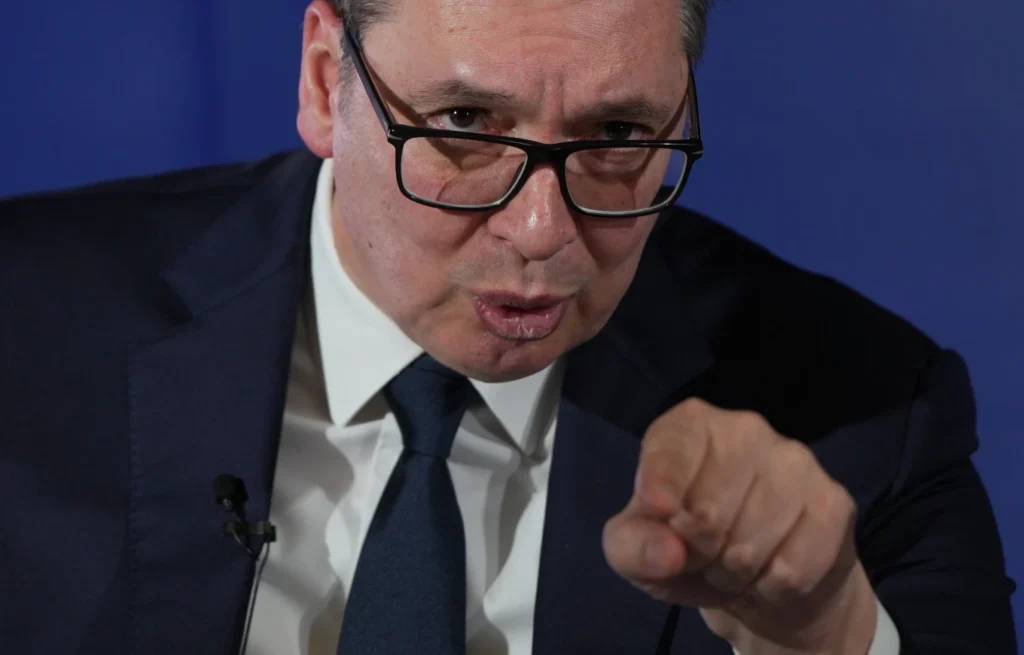
By the standards of Balkan political rhetoric, the interview that Aleksandar Vučić gave this week to Radio Television of Serbia might appear restrained. There were no outright denials of war crimes. No direct attacks on international tribunals. No attempt to refute the verdicts that defined the legal legacy of the Yugoslav wars.
That restraint is the point.
What Vučić deployed instead was something more subtle and, in its way, more durable than denial: a careful recalibration of language around two of the most consequential figures of the 1990s conflicts. Through a handful of phrases — chosen, one suspects, with some deliberation — Serbia’s president attempted to reposition Slobodan Milošević and Ratko Mladić within a narrative of tragedy and human fallibility. Not to exonerate them. To soften them.
The distinction matters because it is precisely what makes the technique difficult to challenge.
Vučić described Milošević as “an intelligent politician who made serious political mistakes.” At first hearing, the formulation sounds almost critical. But it performs a quiet transformation. What international courts, historians, and decades of archival evidence have established as deliberate policies — ethnic cleansing, the systematic use of violence as a political instrument, the calculated manipulation of Serbian nationalism — are recast as errors of judgment. Strategic missteps. The sort of thing any leader, under sufficient pressure, might commit.
Vučić went further, suggesting that Milošević may not have fully understood the consequences of his decisions, particularly regarding the NATO intervention of 1999. The implication is that catastrophe arrived not from intent but from a failure to grasp where events were leading.
The historical record does not support this. Western governments issued repeated warnings throughout the Kosovo crisis. The Rambouillet negotiations in early 1999 made the stakes explicit. Belgrade was not navigating in the dark. Presenting Milošević as a leader overtaken by events he could not foresee is therefore not a factual claim so much as a reframing — one that relocates responsibility from decision to circumstance.
Vučić’s most revealing remark was also his most personal. He reflected that it is easy to judge past decisions with hindsight, but that he cannot truly place himself in Milošević’s shoes. He has thought about it, he said. It was not a simple time.
By inviting the audience to imagine the weight of leadership under impossible conditions, the argument transforms a historical perpetrator into a human dilemma. Milošević ceases to be an architect of policy and becomes instead a man trapped by events larger than himself — the kind of figure who invites understanding rather than accountability.
What Vučić did not mention, and what his interviewer did not raise, is that he was not a distant observer of that period. He served as information minister in Milošević’s government during the Kosovo war — the official responsible for managing Serbia’s wartime media environment at its most controlled and most consequential. His difficulty placing himself in Milošević’s shoes is, in that sense, a curious one. The shoes were not entirely unfamiliar.
This is not to draw a crude equivalence between the two men or their roles. It is simply to note that the rehabilitation of Milošević as a tragic statesman rather than a political agent carries specific implications for the political lineage of Serbia’s current leadership — implications Vučić has no obvious interest in making explicit.
The language around Mladić was starker still. Vučić said that history would judge Mladić’s role and observed that every individual has both good and bad sides.
The difficulty with that formulation is that history has already judged Mladić — not metaphorically but legally. The International Criminal Tribunal for the former Yugoslavia convicted him of genocide, crimes against humanity, and war crimes, sentencing him to life imprisonment. The verdict established his command responsibility for the Srebrenica massacre, in which more than eight thousand Bosniak men and boys were killed in July 1995, and for a sustained campaign of persecution across Bosnia.
Against that legal background, describing Mladić as a man of mixed qualities introduces a moral equivalence the tribunal explicitly rejected. Vučić does not deny the crimes. He does something more politically effective: he relocates them from the domain of established fact to the open terrain of interpretation. History will judge — as though it had not already done so.
What emerges from the interview is not revisionism in its blunt form. There are no claims that Srebrenica did not happen, no attacks on the tribunal’s legitimacy, no language that would trigger immediate international censure. The approach is more calibrated than that.
Crimes become mistakes. Perpetrators become tragic figures. Circumstances become mitigating. And judgment — legal, historical, moral — is deferred to a future reckoning that remains conveniently unspecified.
The domestic logic of this approach is not difficult to read. Serbia’s political landscape still contains constituencies that view the leadership of the 1990s with genuine sympathy, and constituencies that see engagement with war-crimes accountability as a form of national humiliation. Softening the image of Milošević and Mladić without openly defending them allows the government to navigate between those pressures while maintaining Serbia’s stated commitment to European integration.
It is a strategy optimized for ambiguity.
And ambiguity, in the politics of memory, is rarely neutral. Over time it shifts the center of gravity of the narrative. Crimes become controversies. Perpetrators become misunderstood leaders. The past becomes something less settled than the courts and the archives have already established it to be.
That is the real function of soft revisionism. It does not erase the record.
It slowly teaches a society to read it differently.