Jorida Tabaku was in Strasbourg when the European Parliament demanded the repeal of Law 21/2024. On 30 August she reached for a forged Rama post instead. Then she learned it was forged.
By Ardit Rada (Tirana)
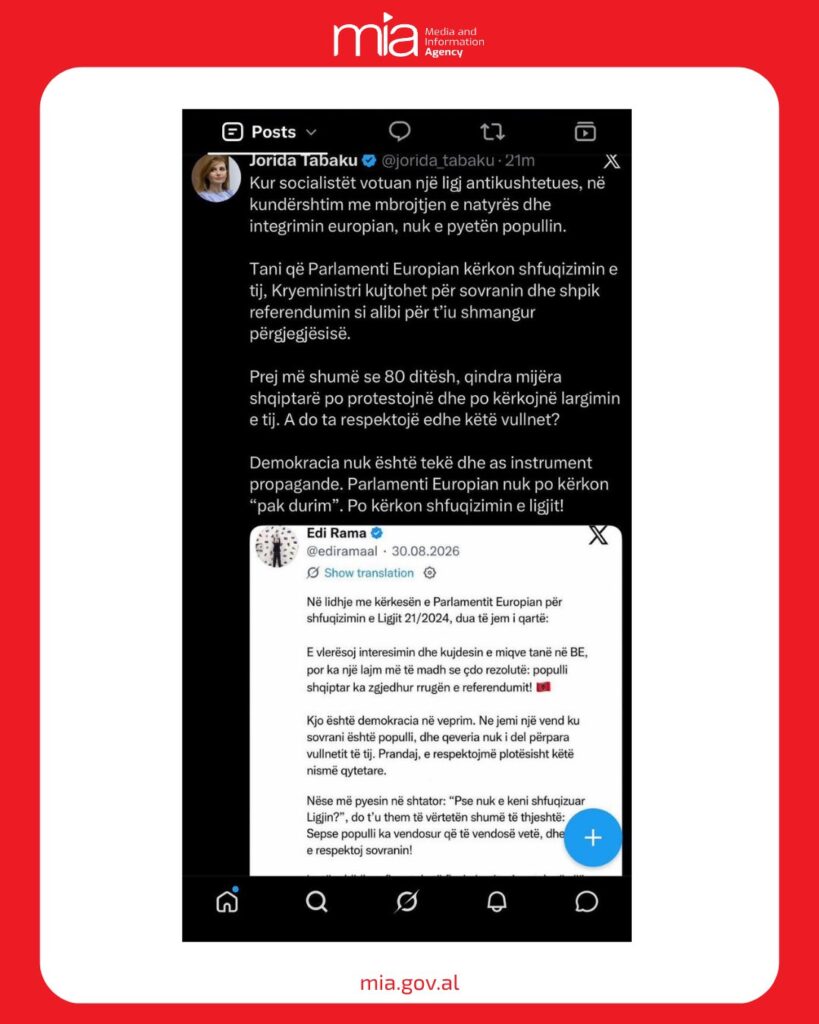
On Saturday afternoon, 30 August, Jorida Tabaku, a Democratic Party MP, shared a screenshot on X. It showed a post from Edi Rama’s account, dated that day, meeting the European Parliament’s demand to repeal Law 21/2024 with a discovery: “populli shqiptar ka zgjedhur rrugën e referendumit” (the Albanian people have chosen the path of a referendum). Above it, her verdict: the socialists had not asked the people when they passed the law; now that Brussels wanted it gone, the prime minister remembered the sovereign and “shpik referendumin si alibi për t’iu shmangur përgjegjësisë” (invents the referendum as an alibi to escape responsibility).
Rama never wrote the post. The referendum, however, exists.
Twelve activists and journalists filed with the Central Election Commission on 6 August to put one question to voters: should Law 21/2024 be repealed. It is the Flamingo movement’s own instrument. The forger placed it in Rama’s mouth as an evasion; Tabaku called it his invention. In one caption she attacked the protesters’ referendum as the prime minister’s alibi, on the authority of a document that did not exist.
The government’s Media and Information Agency answered within the hour: a falsified status, “nuk përmban asgjë të vërtetë” (contains nothing true), withdraw it and apologise.
The calendar removes one excuse, that she lacked authentic evidence. On 17 June the European Parliament adopted its Albania resolution, with an amendment demanding a moratorium on construction in protected areas until the amended law’s incompatible provisions are repealed. Tabaku was there, in a Democratic Party delegation that had lobbied the rapporteur, Andreas Schieder, for those amendments. She recorded a video from Strasbourg after the vote and told Rama to accept it. She held the true weapon for ten weeks and on Saturday picked up a counterfeit.
A forgery like this persuades no opponent. It needs a carrier with credentials and found one in a legislator chairing parliament’s media committee and whose word reaches the embassy inboxes where Albanian politics is read second-hand. The forger supplied the text. Tabaku supplied the credibility, the scarcer commodity and the only part she controlled.
She deleted the post without a word, then posted again. An image, she wrote, is cleared up with a reaction; a law that violates European standards is corrected by a parliamentary vote. Albania needed answers on the facts, not propaganda about a false image. The word apology does not appear.
Being deceived explains the first post and nothing after it. By the second she knew the screenshot was false. Three things were available to her: acknowledge the error, apologise to the audience whose trust had made the forgery worth making, say where it came from. She did none. She reclassified a fabricated prime-ministerial statement as “an image”, filed its exposure under propaganda, and returned to the proposition the forgery was built to prove, that Rama was evading the European Parliament. The fake disappeared. The claim it had put in Rama’s mouth survived without its evidence. The repost tested her judgment; the reply tested her standards.
The usual defence, wrong image but right substance, turns against her: she had the authentic substance since June. The invented evidence added nothing except words Rama never said.
MIA was right, and said so twice, the second time vowing to police disinformation “pa asnjë dallim” (without distinction), whoever produces or amplifies it. It remains a government communications office summoning an opposition legislator, and it can cite Saturday when its next target is a journalist. Tabaku handed it that precedent too.
This is how fake news is weaponised in a small system: a fabricated proof is attached to a real grievance, and when the proof collapses the grievance goes with it. The next deputy who cites the June resolution will be answered with a deleted tweet. The activists collecting signatures share a frame with a fraud they did not commit. Tabaku did not spend the thirty seconds needed to open an account and scroll to a date. Once she knew the post was false, she still did not tell her audience where it had come from.
The government has not answered the European Parliament. On Saturday it did not have to. It answered a screenshot, and won.