Russia has spent 148 years choosing Serbia at the expense of Albanians. Its own arithmetic no longer explains why.
By Albatros Rexhaj (Tirana)
Last week this publication published a letter to the Ambassador of Ukraine in Tirana. It concerned President Zelensky’s answer at the Belgrade press conference of 8 August, where, asked whether Serbia could continue to count on Ukraine’s position on Kosovo, he reaffirmed non-recognition and called it unchanged. The letter recorded our disappointment that a nation defending its own territorial integrity chose, on Kosovo, to stand where Russia stands, and it reminded the Ambassador that Albanians, in Albania, in Kosovo, everywhere they live, have stood with Ukraine from the first day of the invasion. This one continues east.
We wrote that letter knowing the defense it would meet, because the defense was already in circulation: realpolitik. Ukraine is fighting for its life, Serbia manufactures ammunition, and a wartime president reassures the supplier. His hosts in Belgrade make the same argument without embarrassment. On the same Saturday, at Belegiš, President Vučić explained that Serbia maintains friendly and good relations with Ukraine because — jer, his conjunction, doing all the work — Ukraine does not recognize Kosovo as an independent state. Defenders and hosts describe one transaction, and a transaction can at least be read: a price named, a price paid. Keep that standard in mind. This letter is about an account that fails it.
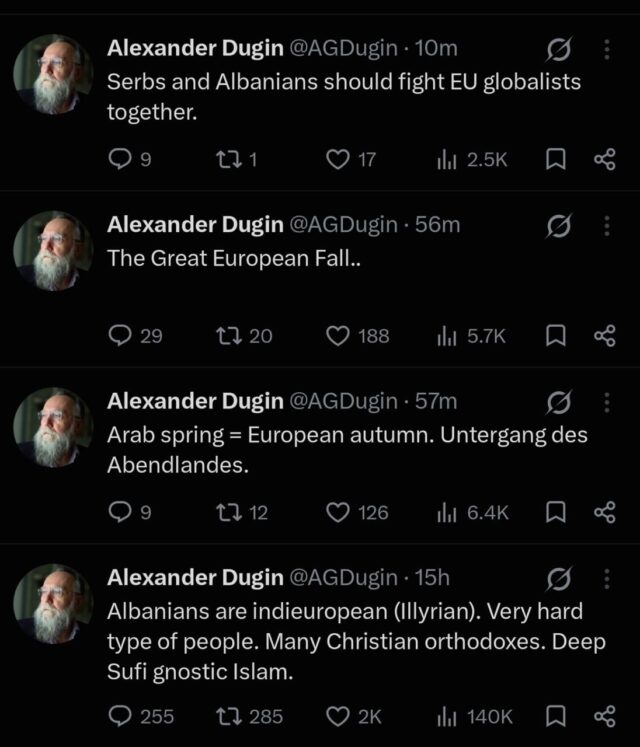
On 10 August, two days after Volodymyr Zelensky left Belgrade, Alexander Dugin devoted his weekly program on Radio Sputnik to the visit and described the world as it will look after a Russian victory. Friends would be rewarded and enemies repaid, and one item on the list concerned us directly. “Our friends,” he said, “would receive Kosovo.”
We address this letter primarily to Mr. Dugin, because his profession is saying aloud what officials prefer to imply, and because in the same broadcast he demands that every nation declare itself plainly. Let your yes be yes, he says, and your no be no. Very well. Ours was declared long ago. And to examine yours, we will borrow a method. The method is Russian. We will come to it.
First, the Albanian side of the account. No Albanian army has ever fought Russia. No Albanian government has ever claimed a meter of Russian ground. There is no border between us, no disputed river, no burned village in either direction. In the war your tradition holds sacred, Albanian partisans fought the Axis, which is to say they fought on your side. From 1945 Albania was a Soviet ally and a founding member of the Warsaw Pact, and at Vlora we handed your navy the only base it possessed in the Mediterranean in those years. In June 1999, when a Russian armored column drove through the night to seize the airport at Prishtina, in the middle of a war Albanians were dying in, no Albanian fired at it.
In two centuries, the sum of Albanian hostility toward Russia is a request, in 1961, that your navy leave a base on our coast which we had given you freely.
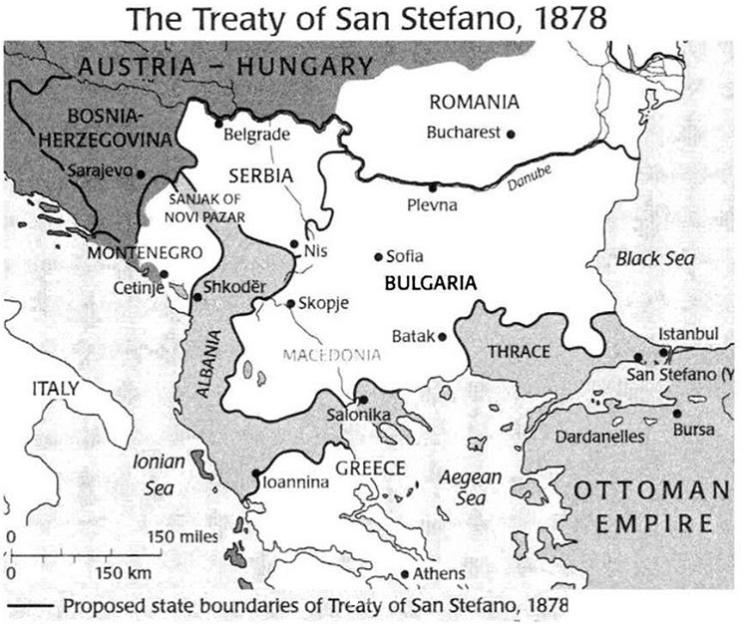
Your side opens earlier, and it opens with a map. The treaty Russia drafted at San Stefano in March 1878 distributed Albanian-inhabited lands to Bulgaria, Serbia and Montenegro. The founding act of Albanian national politics, the League of Prizren, gathered three months later to resist that map. Mark the sequence, because it settles the question of authorship: Russia’s pen arrived thirty-four years before the Albanian state existed. We did not choose you as an adversary. We were an item in your treaty before we were a country. At London in 1913 Russian diplomacy stood sponsor to the Serbian and Montenegrin claims, and the borders drawn there left outside them, by the count our historiography has carried ever since, half the nation, Kosovo included. Then 1999, when you stood by the government whose forces international courts later established had conducted a campaign of expulsion against Kosovo’s population. Then the vetoes, and the non-recognition maintained to this day. By Government Directive No. 430-r of 5 March 2022, your government approved its list of the states it formally designates as unfriendly, and Albania’s name is on it. Lists of enemies, like treaties, are documents, and every document in this file was drafted in one capital.
You will answer with three facts, so let us state them for you. Albania sits in NATO. Albania has aligned with every European sanctions package. And for three decades Enver Hoxha’s Albania denounced Moscow more loudly than any Western capital dared. All three are true. Now put the first two in order. The alliance dates from 2009, the sanctions from 2022, and in 1999 our side was taken against Belgrade, not against Russia; it was Moscow that placed itself at Belgrade’s side of that war. Everything you can charge to our account postdates San Stefano by more than a century. You ask nations for clarity. Our yes to the West is exactly the clarity you demand, and it was formed by reading Russian maps.
Hoxha deserves his own paragraph, since you will reach for him first. His quarrel with Moscow ran through a single question, and the question was Russian: whether to renounce Stalin. Khrushchev renounced him. Tirana refused. In December 1961 it was Moscow that severed relations over the refusal, and Moscow that waited until 1990 to restore them. We defend none of what followed; Albanians bore that regime longer and paid for it more dearly than anyone else on earth. But look closely at what the quarrel contained. No nation appears in it, ours or yours. Two communist parties argued over the standing of a Russian leader, in Russian terms, on a question Moscow itself had opened. And then look at where you stand in it now. You are the author of an essay titled “Joseph Stalin: The Great ‘Yes’ of Being,” published in 1999, of all years. You have called him the greatest of Eurasianists in practice. Last autumn you wrote that the baseness of his critics assisted his elevation. On the one quarrel Albanians ever had with Moscow, the position of today’s Moscow is Tirana’s position of 1961. You broke with us over a loyalty you have since reclaimed.
Now the method, as promised. In June 2024, after the Financial Times counted some 800 million euros of Serbian ammunition moving west since the invasion began, a broadcaster on your own side named Sergey Mardan sat before a Russian audience and read the invoice aloud. Serbian shells, he told them, fragments of Serbian shells, had killed Russian soldiers, and he named the ground where they landed: Ugledar, Robotyne, Bakhmut, Soledar. He did not need to establish the facts, because the friend had already confirmed them on the record. Yes, we do export our ammunition, your dear brother in Belgrade said when the report surfaced; the contracts are with partners, and what the buyers do with the shells afterward is their business. Their business. That is the friendship’s own accounting of Russian dead, in the friend’s own words. Mardan then asked the question his viewers were avoiding: could Serbia have sold those shells to Russia instead? It could have, he answered. It simply did not want to.
Russia was buying its shells from Korea while the brother nation shipped its own toward the opposite trench, and the direction of sale was not forced by any sanction. It was chosen. Then he priced the whole relationship in one sentence we will not soften, because softening it is how it survives: Serbia earned 800 million euros on Russian blood. As usual, he added. Two words, and they carry his entire reading of the brotherhood: not a lapse but a business model, older than this war. He left his audience a definition to go with the number: an empire, he said, is those who get paid, not those who pay the very people selling them out. Under pressure he apologized within a day, and the apology restored the brotherhood in full. It did not correct the arithmetic.
You and he even describe the same event. For the sake of the Serbs, you said in your broadcast, out of loyalty to our Orthodox brothers, Russia entered the First World War and lost an empire. Mardan reads the identical entry and calls it an irrational war for the sake of a Serbia he would not name politely, at the price of the empire’s collapse. One ledger line, two verdicts. Your own airwaves cannot agree whether the Serbian account is sacred or ruinous. They agree only on what the account contains.
So apply his rules to your promise. In this war, Russian blood has had a market price, and it was your own broadcaster who read it out: 800 million euros, collected in Belgrade while Russian soldiers stood under the shells, a trade suspended only when your own intelligence service complained of a stab in the back, and reopened within months, Belgrade again offering shells to the same customers. Against that record you propose, after a victory that has not come, to make a gift of Kosovo to this customer. Consider what the gift completes. By the definition he supplied, an empire is those who get paid. In this relationship Russians have already paid twice, once at the front and once through the invoice, and your program volunteers a third payment, in us. You would settle the account for Russian blood by adding a gratuity in territory, and the territory is where we live.
Mardan’s audit stopped one step short, and this letter takes the step. He asked what the pursuit of Serbia had cost Russia. He never asked who else was billed for it. We were: the map of 1878, the borders of 1913, the vetoes, the list of 2022, a hundred and forty-eight years of expenditure against a people who never fired at you, in pursuit of the client your own auditor values at nothing. And he established one more thing without meaning to. In this entire file, the word choice belongs to everyone but us. Serbia chose its customers. You choose your friends. We were entered on the enemy list without ever being asked a question.
So we end with his device, since it is the honest one. Ask yourself the simple question. Ukraine’s conduct in Belgrade has been defended to us as realpolitik, by its admirers and its hosts alike, and we could at least read the price. Yours has no price attached that any auditor on your own channels has been able to find. Is your hostility toward Albanians realpolitik, or is it simply what you prefer?
We do not require the answer quickly. As you say, you have time.