Ana Brnabić has placed a demonstration for men presumed innocent beside state honours for a man finally convicted of genocide. Her argument depends on treating those as the same thing.
By Ardit Rada (Tirana)
On Wednesday afternoon, two days after Ratko Mladić was buried in Belgrade, the Speaker of Serbia’s National Assembly published a list. Ana Brnabić wrote it in English and addressed it to the European Union. “Serbia does not ask for special treatment. Only equal treatment,” she wrote, and she offered seven episodes from the region that in her account drew no comparable reaction from Brussels. Tirana comes first.
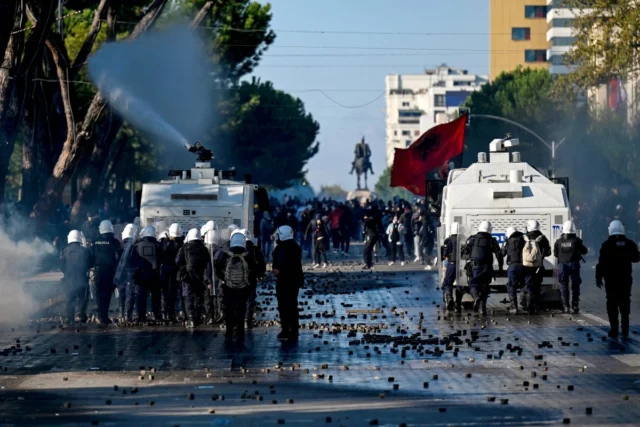
Her entry: on 17 October 2025, thousands gathered in the Albanian capital in support of Hashim Thaçi and three other former KLA leaders on trial in The Hague; the president, the prime minister and senior ministers supported the demonstration; motorway tolls were suspended; no EU measure followed.
Accept every word of it. A crowd filled Skanderbeg Square, President Bajram Begaj posted his support, Prime Minister Edi Rama urged people to come, and the toll at the Kalimash tunnel was waived for the day. Set that beside Belgrade on Monday and ask why one drew a reaction and the other did not.
The answer begins with the men.
Thaçi, Kadri Veseli, Rexhep Selimi and Jakup Krasniqi were transferred to The Hague in November 2020. Their trial opened in April 2023. The evidence closed in December, closing statements were heard in February, and the Kosovo Specialist Chambers has scheduled the pronouncement of the trial judgment for next Wednesday, 16 September. As of today there is no judgment, not even a first-instance finding for anyone to appeal. All four remain presumed innocent, in the law of every state the Speaker was writing to and in the law of Serbia.
Mladić was convicted of genocide, crimes against humanity and war crimes in November 2017. The Appeals Chamber confirmed the convictions in June 2021. When he died, nothing about his guilt was left for any court to decide.
So the Speaker’s list opens by putting a demonstration about a case with no verdict beside honours for a man with a final one, and does it in a single line. Albania’s foreign minister, Ferit Hoxha, responding to a Tirana Examiner inquiry, did not go along with her:
“This is ridiculous, to say the least. Comparing a person who is currently on trial and presumed innocent with someone who was finally convicted of genocide, crimes against humanity and war crimes is a deliberate distortion of both fact and principle. An ongoing trial is not a conviction, and the presumption of innocence is not glorification. To deliberately conflate the two is not only preposterous; it is a fundamental misunderstanding, or intentional misrepresentation, of the rule of law.”
The Tirana rally was organised by the KLA veterans’ organisation. It was a demonstration by citizens directed at a court, demanding justice for men still on trial. Begaj expressed his view on Facebook. The former president Alfred Moisiu stood in the crowd. Even on the Speaker’s own account, what she is describing is a political demonstration about an unfinished proceeding. The officials she names expressed support. They did not turn the demonstration into an act of state.
In Belgrade the state did the work itself. A government aircraft brought the body home and Serbia’s justice minister, Nenad Vujić, met it on the tarmac. Serbian Army soldiers carried the coffin off it. The Gendarmerie saluted the cortege on the motorway. There was a commemoration in the Army House, Patriarch Porfirije conducted the rite, and the Russian ambassador spoke to Russian television at the graveside. Afterwards each piece was explained separately: procedure, protocol, someone attending in a private capacity. A crowd and a state are different actors, and a demonstration and a funeral with military elements are different acts. No toll arrangement converts one into the other.
The Speaker has six other examples. They concern other capitals and other institutions, and those capitals can answer for them. This newspaper is concerned with the example she placed first, and with how it is being used. The list is built so that a question about one act in Belgrade is met with another capital, and a specific act with a general grievance, until the whole region is invited to answer together and nobody answers for Monday. Tirana is not joining that arrangement. A demonstration for men who have not heard their verdict and honours for a man who exhausted every appeal do not sit in one column, and Albania does not have to explain the first before it is allowed to name the second.
Tirana is on the list because the argument needs it. But the comparison only works after several things have been quietly changed. Men awaiting judgment become men already convicted. A demonstration becomes an act of state, and support for defendants who have not yet heard their verdict becomes the glorification of genocide. Put the categories back where the law keeps them and Tirana falls off the list.
Brnabić says Europe does not treat Serbia equally. Tirana does not prove it, and it will not be borrowed as an alibi the next time Belgrade is asked about its own choices.
The Speaker is entitled to defend what Serbia did for Ratko Mladić. She is not entitled to use Tirana to make it look like something else.