The four billion euro South Adriatic project is being fought as a catastrophe. The European record, and the names on the drawing boards, suggest something closer to the opposite: a test Albania has set for itself, and one it can pass only on terms it must now make public.
by Besart Ruka (Tirana)
There is a peculiar quality to a protest organized against a building that does not yet exist. The crowd that gathered at Zvërnec, and then in front of the prime minister’s office, came to demand the cancellation of an architectural project that has not been drawn, let alone approved, let alone set into the sand of the southern Adriatic. The reply from the government was close to arithmetic in its simplicity: bring the project and it will be cancelled. The trouble is that there is nothing to bring. The design is still on the boards of five studios, and until it leaves them there is no plan to oppose, only a vacancy that fear has been invited to fill.
That vacancy is worth examining before the renderings arrive, because the argument over Zvërnec is not really an argument about a drawing. It is an argument about whether Albania is permitted to attempt something ambitious on its own coast, and about who gets to decide the answer before the evidence is in.
Start with the names, since the government has put them on the record. The architectural project is being developed, according to the prime minister, by Kengo Kuma of Japan, Bjarke Ingels of Denmark, Jean Nouvel of France, Emre Arolat of Turkey, and K-Studio of Greece. This is not a roster a country assembles when it intends to bury a coastline under concrete. Kuma designed the national stadium for the Tokyo Olympics and has spent a career arguing that architecture should defer to landscape rather than conquer it. Nouvel holds the Pritzker Prize, the discipline’s highest honor. Ingels runs one of the most consequential practices of his generation, Arolat is the leading architectural voice in Turkey, and K-Studio has defined a quietly modern Mediterranean idiom across the Aegean. You do not hire these five to insult a place. You hire them when you have decided that the place deserves the best work in the world, and when you expect that work to be scrutinized in detail by people who know the difference. That decision, taken alone, is the most important thing Albania has yet said about Zvërnec, and it has been almost entirely lost in the noise.
Then consider the scale, because the strategic case rests on it. The developer, operating as Zvërnec South Adriatic Development, describes an investment exceeding four billion euros, more than ten thousand jobs created directly and indirectly, and a contribution of three to four percent to national output over five years. The capital, by the government’s account, comes from Qatari investors connected to the Power Holding group and from American partners. Treat these as the representations they are, claims to be tested rather than facts already proven, and the strategic meaning still holds. For most of the post-communist era, the problem was not that Albania chose the wrong investors. The problem was that serious international capital did not come at all. A four billion euro commitment from Gulf and American money is the clearest signal yet that the calculation has changed, that Vlora is now a place where the first tier of global tourism capital competes to enter rather than declines to look. A country spends decades trying to move from the third division of Mediterranean destinations to the first. This is what the attempt looks like when it finally arrives, and it does not arrive quietly or without cost.
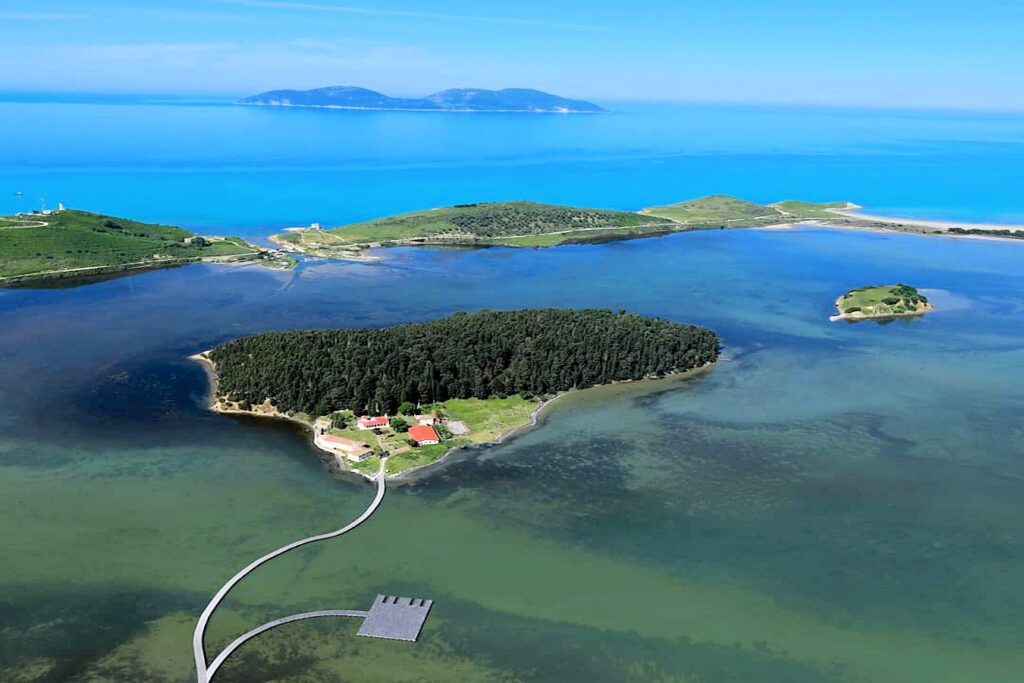
The substantive objection, the only one that deserves the name, is environmental. Zvërnec sits in one of the most sensitive coastal landscapes Albania possesses, beside the lagoon and wetland system that has made the Vlora gulf a fixture of every conservation map of the Adriatic. To build there at all is to accept a real responsibility, and anyone who pretends otherwise is not defending the project but flattering it. The honest question is not whether the landscape matters. It plainly does. The honest question is whether development and protection can occupy the same shoreline without one destroying the other.
Europe has already answered that question, repeatedly, and the answer is yes, under conditions. The Venice lagoon, the largest coastal lagoon of the Mediterranean, carries UNESCO, Ramsar and Natura 2000 status simultaneously while hosting a living city, a major port and centuries of intensive tourism. The Étang de Thau in France runs a shellfish economy and a tourist economy inside a Natura 2000 site, the two industries built directly on the natural value they depend upon. Arcachon survives as a destination precisely because the quality of its lagoon survives. Most instructive of all, Port Leucate and Port Barcarès are resort towns with one of the largest marinas of the European Mediterranean, raised from nothing on the sand cordon of a protected lagoon in the 1960s, functioning for half a century alongside oyster farming and a protected bird habitat. None of these places chose between nature and prosperity. They chose to manage both, and they are still here.
The clearest mirror for Zvërnec is the one the prime minister himself reached for. Costa Navarino, in Greek Messinia, was built next to the Gialova lagoon, a Natura 2000 wetland that shelters more than two hundred bird species and the only African chameleon population in Europe. Before a stone was laid, the same prophecies now heard at Zvërnec were heard in Messinia. The water would run out. The biodiversity would collapse. The coast would be lost. Today Costa Navarino reports a seventy five percent cut in operational emissions against its 2019 baseline, electricity drawn entirely from renewable sources, and irrigation covered by captured river runoff and recycled water. Those figures come from the developer’s own accounting and should be read as such, but the trajectory is not in dispute. The resort became one of the most decorated sustainable destinations in the Mediterranean, with its golf courses independently certified, its research observatory run jointly with Stockholm University and the Academy of Athens, and its conservation programs run with the Greek partner of BirdLife International. The doom was confident, specific, and wrong. What made it wrong was not luck. It was the decision to engineer an answer to every objection rather than dismiss the objection.
This is where the case for Zvërnec must be honest about its own conditions, because the European record contains a warning as well as a precedent. The Mar Menor in Spain, the largest saltwater lagoon in Europe, was developed hard along its shore and then poisoned, not by the hotels themselves but by a failure to govern the nutrients and discharges flowing into it from the surrounding land. The 2016 collapse turned its water to a green soup and killed the bottom vegetation, and the mass fish deaths of 2019 and 2021 followed. The lesson is exact. Development that outruns its management does not merely risk the asset. It destroys the very thing from which its value is drawn. Assessment and stewardship are not the enemies of the investment. They are the only guarantee that the investment survives.
So the defense of Zvërnec cannot be that protected status is no obstacle to building. It is that coexistence is achievable only on terms, and that the terms are now Albania’s to enforce. The developer says it has spent two years commissioning environmental studies from leading global firms and that those studies, along with the architectural project, will be published. That promise is the whole argument. If it is kept, if the environmental assessment is released in full and submitted to independent scrutiny before the first foundation, then Albania will have applied the highest standard it has ever brought to a coastal investment, and the project will deserve to be judged on that standard rather than on rumor. If it is not kept, the opponents will have been right for the wrong reasons, and the warning of Mar Menor will have gone unheard. The case for the project and the demand for transparency are not in tension. They are the same sentence.
That is also why the manufactured part of this campaign should be named and set aside. The claim that Zvërnec has been handed to Israel to build a Palestinian ghetto is not an environmental concern. It is a fabrication, antisemitic in its construction and absurd in its content, and the speed with which it attached itself to a planning dispute, alongside questions about organized transport arriving for the protests, tells you that not everyone in this fight came for the lagoon. Genuine ecological worry deserves a genuine answer, and it is getting one in the studies still to be published. The conspiracy deserves only to be identified for what it is, so that the citizens who love this coast are not used as cover for those who are merely paid to inflame them. The violence shown to a protester by private security was indefensible, and the state was right to say so without hesitation. But the brutality of one guard is a question of policing and accountability. It is not a verdict on a four billion euro investment, and it should not be allowed to become one.
Albania’s choice at Zvërnec was never between a pristine shore and a ruined one. It is between drift and a disciplined transformation, between leaving the gulf as a postcard no one profits from and turning it into the destination the Mediterranean has not yet built. The five studios are the proof of the ambition. The published assessment will be the proof of the responsibility. The country has set itself the highest bar it has ever attempted on its own coast. The honorable thing now is not to lower it in fear, but to hold the investors to it in full daylight, and to let the work, when it finally leaves the drawing boards, be judged by what it is rather than by what its enemies needed it to be.