by Edi Rama (Prime Minister of Albania)
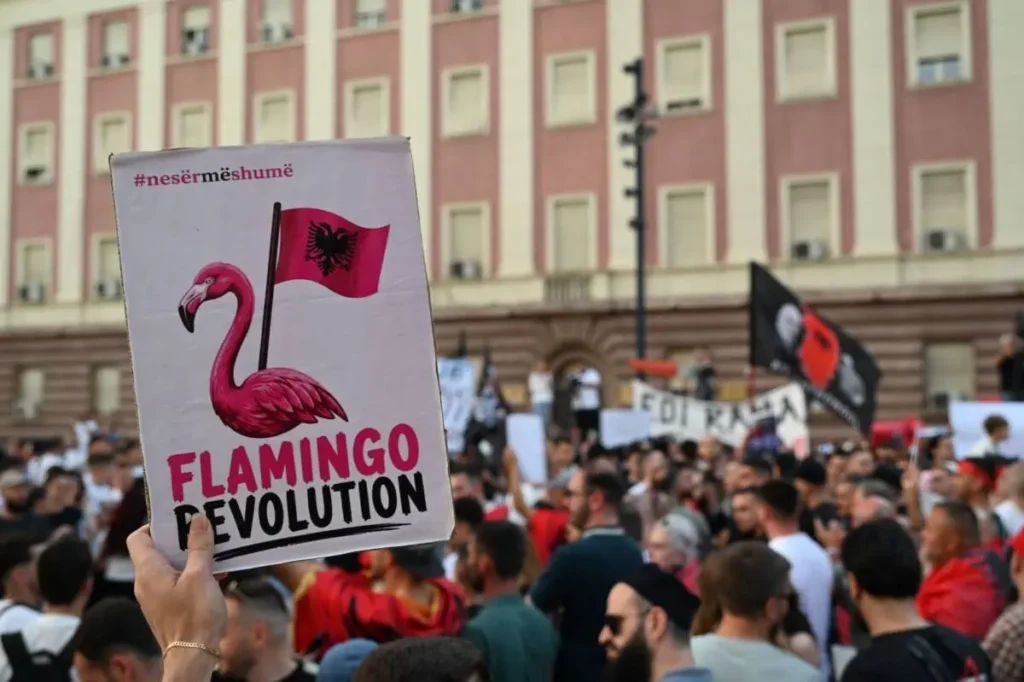
I have come today to speak to you about what we saw and heard during the month of June, when the boulevard filled with people from every walk of life, every social category, every age — and when a rare bird, beautiful and fragile, became the symbol of the greatest wave of global attention Albania has ever experienced. Within a single month.
Besides the video you just watched, to which I will return later, I have also brought two documents with me for you today.
They are two documents that embody my reflection before the mirror of the Boulevard of the Flamingos, and they are open to be read, analyzed and amended, so that they may serve their purpose as well as possible.
The first is a strategic document, on the turn that the fourth mandate must guarantee in the process of governing. The second is an annex, on how the Socialist Party must support the turn of the fourth mandate.
Let me begin with an episode you may already have heard.
On one of those June days, a mayor — one of our own, a man who stays on top of his work and his community — came to me badly irritated by a group of citizens who had come out to protest over a problem in their neighborhood.
“I found them in the muck,” he told me. “They had no road, no sidewalks — street lighting wasn’t even a subject; nothing but potholes, brambles and garbage. I gave them a road, sidewalks, lights, trees. I turned it into a garden for them and even put in benches. And yet they are ungrateful.”
That colleague, dear friends, is all of you. Because every one of you has thought that ugly word at least once — when your patience has run out in the working relationship with the people; about someone, about something, or often about several people at once: that people are ungrateful.
That word is the starting point of the perspective we need. Because precisely in its content lies the most mistaken understanding of the new phase Albania has entered.
That is why I want to say it myself, right at the outset and straight to their faces — to those who protested against that mayor; to those who came out onto the boulevard during June; and to those who have protested silently or aloud, alone or with others, anywhere across Albania, ever since the elections of June 2025:
You are not ungrateful. You are the new measure of our standards.
You, out there on the periphery of a municipality — you did not protest against what the mayor had done for you, and least of all against the man himself.
You who filled the boulevard and the social networks with your protest — you did not protest against the Albania we built over our three mandates.
And here let me single out, in particular, those — and they were not few — who were voters, supporters or even members of the Socialist Party; and those, too, who spent their days working in the administration of the state and their evenings at the protest. They did not come out onto the Boulevard of the Flamingos to deny the transformation of Albania, to attack the government, or to chant “Rama, resign.”
Those who voted for us came out and joined the others, even when the protest was directed against me, because its gravitational force was more compelling to them than my figure. Those from the administration — many of whom may never have voted for us — came out with the others because the new Albania does not live in the shadow of the old one, when people were thrown out of state jobs together with their whole kith and kin, for attending one of our meetings while we were in opposition, let alone for protesting against the government.
All of those citizens together gathered there in such numbers — before the crows and the ravens had even poked out their heads — because they were driven by an inner need to convey a message stronger than their belonging to any party or the color of any government.
The contagious taste of the freedom of that protest, and the need to join that extraordinary river of people — stepping out of the alleys of daily routine and feeding their phones with a dazzling, Instagrammable energy — were more powerful than our entire arsenal of facts against the lies, the slanders and the accusations surrounding the Zvërnec project.
The news I have for you today is this:
Our facts are no longer enough.
Because in the Albania that we radically transformed, people no longer live on the satisfaction of the changes taking place, nor on the encouragement of the things being built, as they did until yesterday — when they waited with confidence that after the road, the school or the park built in the next neighborhood over, the turn of their own road, their own school, their own park would come.
Today they live with expectations that grow faster than our capacity to answer them. And in an Albania developing at a new pace, they experience development as a tension between what they see and hear and what they have; sometimes as a source of questions about what is being done with the country, and often as a feeling of insecurity about their own share in an economy that is growing fast — but growing together with the cost of living.
In other words, comrades, it is no longer enough to govern the present with investments, achievements and integrations, showing what we have done up to this point. We must govern in harmony with the everyday experience of today’s citizen. Because the hearts and minds of Albanians are no longer fixed on what changes across the territory, nor do they attach themselves to positive economic statistics; they are anchored to their own expectations.
THE MIRROR OF THE FLAMINGOS
That is why the Boulevard of the Flamingos must be seen not as a protest, but as a mirror that society held up before us — challenging us to look at ourselves and to verify, seriously, whether our minds and hearts are in the right place to govern the Albania of this new phase; a phase which we, before anyone else, absolutely must understand in all its dimensions.
I myself, in the mirror of the Boulevard of the Flamingos, saw the closing of one era and the opening of another.
The era that has closed is the era of scarcity: when a new road was a collective victory; a new school was a shared celebration; a new park was greeted with applause, and the switching-on of streetlights in a neighborhood was received with blessings.
In the era of scarcity, societies suffer along the roadless roads of ruin and humiliation, and they rejoice at every change the way a child rejoices at a gift.
Their tolerance for what is missing is vast. The motto of that era is: it could be worse.
The era that has opened is the era of expectations, where the new road is a standard, not a victory; the new school is a debt repaid late, not a reason to celebrate; every good service is taken for granted, and no absence of service can be endured any longer as it was in the era before.
Society no longer even entertains the thought of whether things could be worse. Its tolerance for whatever goes wrong is dwindling toward zero, because the motto of this era is: it can be better.
Alexis de Tocqueville, one of the keenest students of democracy and social change, left us a written warning tailor-made for the phase we have entered: the most dangerous moment for a government comes precisely when it has begun to change things.
And the examples of the change we have brought to this country are countless, while the danger he speaks of is by now perfectly legible.
For a hundred-odd years in Albania, no senior official had ever been investigated — much less tried — independently. Corruption had been accepted by everyone as though it were the fatality of a natural disaster.
I remember how, when people supported the justice reform with both hands, left and right, demanding the Vetting the way believers demand a savior, they nonetheless answered massively “no” to the question of whether they believed they would one day see senior officials brought before justice.
Our justice reform raised the fight against corruption to levels that until yesterday were unimaginable.
The monument of impunity fell — as, until yesterday, could not be imagined.
But that fact is not remotely enough for people to rejoice in this historic achievement.
On the contrary: it is more than enough for them to be dissatisfied that more is not being done.
For thirty years Albanians stood in kilometer-long queues for the most elementary services — waiting in rain and sun for an ordinary document, shoving to pay their electricity bill, or coming from abroad to spend half their holidays at counters that looked like the doors of the city bus at the hour the workers poured out of the combine.
They had accepted that reality as though it were an immovable inheritance.
Today, 95 percent of public services in Albania are obtained by phone, free of charge, from any point on the globe. But that fact is not remotely enough to make people more tolerant of the services that still limp. On the contrary — it is more than enough for their tolerance to be practically zero.
I don’t know whether you heard me tell, one day, the story of the mother of a friend of mine — an eighty-year-old grandmother. She, too, came out to protest. Not over Zvërnec. Not over the protected areas law. She came out because every time she needed to be seen at the polyclinic for a chronic illness, she rose before daybreak to hold her place in the queue, because the doctor came to work late and stayed only two or three hours.
We can recite to that grandmother how many hospitals we have rebuilt, how much equipment we have bought, how our health system has changed like night into day compared with the time we took office.
All of this, and everything else we might enumerate for her, are facts as plain as sunlight. But her fact is the experience of the polyclinic queue before the sun has even risen.
And when our facts collide with the grandmother’s experience, we cannot ask her to change her experience. It is we who must change — so that her voice is heard, her trouble is aired, her experience changes, and she sees that the state does not begin and end with the wretched manners of that doctor.
Otherwise, all the changes we have made in health care will remain where they are, as undeniable fact — but we will no longer be here, if we go on believing that investments and the facts of progress are enough for people to keep investing their trust in us, when nothing meaningful changes in the quality of their experience with the state.
Here again, Tocqueville comes to our aid: the abuses that disappear make the weight of those that remain all the more unbearable.
When the spirit of progress becomes durable and development unstoppable, citizens’ expectations do not fall — they grow faster than the very speed of change. And no success lowers the demand. It only raises it.
It is with this eye that you must also watch the video I showed you at the opening of this speech.
When we took office, the forests were being felled as if under assault by an army of aliens in the form of chainsaws, and animals were being killed for the bestial appetites of foreign hunters, as though Albania were a game reserve beyond the map of civilization; while about the heaps of bird carcasses in the lagoons, the occasional international nature magazine would write a piece — but God forbid a voice should rise that carried beyond some television segment slotted in before the weather report.
In a country where society was suffering its own great deprivations, and where statistically a person was killed every three days, there was no way there could be any optimistic expectation for the lives of animals.
In one decade, we carried out a historic reversal in the vision, the approach and the administration of Albania’s flora and fauna. With exemplary results.
We made the first law on protected areas integrated with the standards of the European Union, and over this decade we expanded their surface area, added categories of protection, and turned the preservation of nature from a sporadic appeal into a system of administration.
(A parenthesis here: the 2024 amendments to that law were used relentlessly as gasoline for the fire of the protest by individuals with political agendas of their own — including certain members of the European Parliament who, in the best case, never read them at all and fell victim in good faith, and who, in the worst case, wished to play the victims of American imperialism.
But the truth is that those amendments were made in accordance with the European directive and, fortunately, in execution of the negotiations calendar, they will be scanned one by one with the European Commission, to align that entire law, one hundred percent, with the EU directive. So this manufactured conflict will be resolved beautifully along the road of negotiations, where nothing passes without the Commission’s approval.)
Now, let a single person raise a hand — here, beyond these walls anywhere in Albania, or beyond Albania’s borders — and say that they had imagined, in the days of the deafening choruses of chainsaws and the booming choruses of exterminating shotguns, that the day would ever come when, on that very same boulevard — where, in that era of saws and shotguns, protesters were killed like the birds of the lagoons, with bullets fired from the windows of the Prime Minister’s Office — a mass civic protest would surge forth over the fate of the biodiversity of one of the country’s lagoons.
And yet the day came — far sooner than it could have been pictured by anyone who, back then, would have named a date for it only under duress; and Albania, where until yesterday nature and the populations of its species were the unprotected prey of a man unchained from every ethical, moral and legal restraint toward Mother Nature, became the country of a popular protest in defense of biodiversity.
And not only that — a protest to defend it from none other than me and you, we who restored to biodiversity the commitment of the executive and the legislature, with results that are anything but modest.
Ingratitude? No. In no way.
Here too, the key is handed to us by the man who understood it very early and more clearly than most, Tocqueville: discontent does not grow simply in a reality where people have lost hope, but above all where hope has grown faster than reality. Because when a society becomes convinced — by the very fact that change is happening, by seeing with its own eyes that change is possible — everything that has not yet changed becomes far more unbearable to it.
The Boulevard of the Flamingos is the most exemplary proof that Albanians no longer compare Albania with the country of scarcity from which we set out, but with the country of opportunity at which they expect us to arrive.
That is why they no longer credit us merely for what we have changed. Indeed, they almost seem to want to forget even the part they still remember.
Because they are focused on judging us, with less and less mercy, for everything that — precisely because they saw how much can change — they can no longer accept remaining as it was.
And so, comrades, the crossroads I have spoken about before — without being properly understood, and without myself being able to perceive it properly before I saw myself in the mirror of the Boulevard of the Flamingos — is exactly this:
We pulled Albania out of the era of scarcity. No one else. We did.
And therefore today we face a people that no longer measures Albania by its deprivations, but by its own expectations;
a people that no longer values us as much as we would like for everything we did, but demands an account from us — more than we would like — for everything that remains to be done;
a people that grows irritated when we show them from how far down we started in order to climb this high, and that shows us instead how much higher it intends to climb. With us, or without us.
And they are right. Period.
Whoever attempts to diminish or relativize the magnitude of the right that the Boulevard of the Flamingos showed us will himself be diminished and relativized into irrelevance.
More than that: the bigger and stronger you are when you stand before this right, the more endangered you are if you fail to understand that this right is bigger and stronger than you — even if you are the Socialist Party itself, even if your name is Edi Rama.
For three mandates in a row we spoke the language of facts. How many roads. How many schools. How many hospitals. How much investment. How many tourists. How much economic growth.
The facts are there and will remain there, stubborn witnesses to how we transformed this country — from a reality that made the news only for the worse, with a state on its knees where there wasn’t even electricity because half the country was paying for the other half too, and with a name internationally disregarded — into a desired destination, with a flag internationally respected.
But that is now history.
In the mirror of the Boulevard of the Flamingos I saw one great truth that no statistic reveals — and no evidence refutes: we, up above, had the facts; the people, down below, had the lived experience.
Our fact was that the Zvërnec investment stands on private land. Their experience was that the state’s land was being sold to foreigners.
Our fact was that the project remains, to this very day as we speak, in the hands of a team of architects, environmental engineers, geologists and hydrologists among the finest in the world. Their experience was that construction had already begun and the project had to be canceled.
Our facts said that the truth was with us; but their experience was that the truth was entirely on their side.
Without question, there was foreign interference in that protest — brutal interference, in fact — abundant manipulation, fake news, doctored videos, and plenty of actors planted with the most varied intentions in the service of multiplying the anger.
These, too, are facts, and they were important parts of the protest. Exposing and analyzing them is indispensable to understanding that protest in every dimension.
But none of these, nor all of them together, were the heart of that spectacular manifestation which turned the boulevard into the most visible chasm imaginable between our facts and the people’s experience.
The answer to the foundation of that chasm must not be sought in those appended parts of the protest; it must be found in the risen expectations of the people. Whether we like it or not, people expect more with every passing day and grow ever less tolerant — above all of their bitter experiences with the administration, which, like thousands of drops collected from top to bottom, made the cup of patience overflow onto the Boulevard of the Flamingos.
That chasm did not open in order to remain open. It opened in order to be closed.
And it cannot be closed by pretending it closed on its own, just because the boulevard emptied of flamingos and all that remained were the feathers of the luckless and the eggs of the wicked;
nor by simply clutching harder at the facts and imagining that the people’s experience will change once we repeat our facts to them a hundred more times;
nor by simply shuffling some personnel around and convincing ourselves that the people will be convinced once they see the works with their own eyes.
None of these, nor all of them together, can suffice to close that chasm.
To understand that chasm to the very bottom, forget our facts and focus on the people’s lived experience. Because when a chasm of that kind opens between our fact and their experience, it has been opened by the collapse of the belief that expectations will be fulfilled.
And when belief has collapsed for that reason, even the most stubborn fact begins to look like a lie; and — worse still — even the biggest lie begins to look like the truth.
HOW AN ALBANIAN FLAMINGO BECAME WORLD NEWS
Of course, that protest cannot be understood without the overloaded cloud of digital data above the Boulevard of the Flamingos, which gathered and released an infinity of signals to every corner of the globe.
Because Zvërnec was not carrying only the weight of a major investment, a sensitive lagoon, questions over property and a debatable decision — all of which generated a magnetic force across planet Earth after the virality of a video in which the fragility of the protesting individual collides with a high barbed-wire fence, exactly like an impassable border between his life and a great highway of development that has flung him out of its course.
Over Zvërnec there also hung the shadow of the most polarizing name in world politics and media, Donald Trump — since at the center of the project stood Jared Kushner, the son-in-law of the President of the United States, together with the President’s daughter.
Without that connection, the protest would at best have been an Albanian affair beyond the world’s attention; but thanks to that connection, it instantly became a global legend, in which many a foreign fan of the protest — including the mythic senator from Vermont, Bernie Sanders — wished to see Albania as the brave parable of a small David rebelling against an all-powerful Goliath, calling on the whole world to learn from Albania the road of liberation from capitalism.
Such is the fact of the age of social channels in which the world swims today.
Zvërnec supplied the outrage-inducing video.
The flamingo supplied the mesmerizing symbol.
The shadow of the world’s most famous father-in-law supplied the global magnet.
And the Algorithm — egged on by master craftsmen of interference in the affairs of other countries — did the rest: with one lit match beside a pine grove in Nartë, it spread, within a few hours, a dizzying fire across the entire world.
The zeal of Trump’s adversaries everywhere — to fight him at every moment, over everything, and wherever possible — turned the boulevard-become-chasm into a stage of identification for hundreds of millions of people across several continents.
But the cause of the chasm was us, and the heart of the protest was the ordinary people of this country.
Therefore the answer owed to them must be ours — not that of the charlatans, the extremists, or every public failure who on such occasions is always found at the ready, with miracle-working recipes for the people, all written on the same principle: Come on, men — let’s tear everything down, so everything gets fixed and I get to grab something.
They needed the wound.
They did not create the protest.
They hijacked it, and they go on embodying it — like the sludge that settles once the flow of running water has dried up.
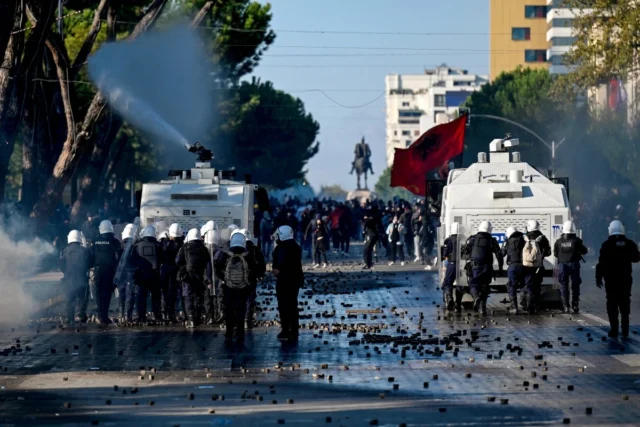
Now they keep scratching at the wound with nervous fury, gathering like black feathers over the boulevard or around the parliament, after the heart of the protest has departed together with the flamingos.
They are not the enemies of Albania; they are its blind sons, most of whom walk without knowing where they are going, and who have no inkling that they are, at the same time, cannon fodder for Albania’s foreign enemies and ill-wishers — first among them the state actors, who unleashed through the digital cloud massive volleys of avatars under fake profiles, which by now we have documented.
And what interest do these malign craftsmen have in Albania? No interest other than chaos and the demolition of trust — so that Albanians no longer believe anyone: not the state, not the media, not the justice system, not Europe, not one another.
Because a country without trust is a country undefended, and a democracy without trust is a minefield.
The fact that, for the first time, Albania tasted the foul flavor of religious division and ethnic hatred — which manifested themselves, to the shame of everyone, along the route of the protest — was directly an objective of their operation.
The targeting of the Jewish nation with an antisemitism unknown to Albania — going as far as the tearing down of the flag of the Israeli embassy, itself incited by foreign elements who in that instance penetrated the protest with their physical presence, exploiting a handful of the local blind — was a public violation of the sacred memory of those Albanian families, Muslim in their majority, who earned Albania eternal glory and honor by taking Jews under their protection at the cost of their own lives.
But here, too, I want to be very clear. Neither the interference of foreign state actors, nor the staggering sponsorship of digital volleys by the lobbies of the competing Mediterranean tourism industry, invented the anguish that brought the flamingos out onto the boulevard.
They unquestionably exploited that anguish savagely and worked hard to turn it into an uncontrollable fire — whose consequences for the tourist season, and for the economy of the families who live on tourism, were shown plainly by the end-of-June balance sheet, when for the first time in many years, and in complete counter-tendency to January–May, which had been on fire, growth came to a halt in the figures for this past June.
But I want to be equally clear that, in showing the people that this too was happening, it never crossed my mind to accuse the sincere protesters of being accomplices of the killers of Tehran, or puppets of whoever else was planted, together with Iran, in the public’s mind through all manner of sinister postings and hate-laced comments.
Nor has it ever crossed my mind, nor does it now, that declaring the protesters enemies and the critics agents could be my response to this negative novelty — which brought our enemies inside our own house, not through cyber-bombardment as some years ago, but through the flooding of the social channels: something we had, until June, only heard about from the unbelievable stories of other democratic countries.
And beyond the indispensable strengthening of our defensive technological capacities, we must extend our response to this, too, into the closing of the chasm — by listening earlier, explaining more clearly, and above all by doing so with empathy for people.
WHAT WE MUST ACCEPT
After the great victory that gave us 83 seats, I have said it in several internal meetings with you: that victory, as much as it is a blessing, is also a curse.
A blessing, because it gave us the strength to continue the transformation with the people’s great trust. A curse, not only because, after that great trust they gave us, Albanians see in us the cause of everything that goes wrong — but also because great victories like last year’s turn every collision between reality and the citizen’s expectations into an added weight, badly borne.
And this, however merciless it may seem to you, is the consequence of the fact that we ourselves made Albania a country where no one draws comparisons with yesterday anymore — everyone draws them with developed Europe.
But not only do we have no right to complain about being judged this way; we must also accept the thing that hurts the most: often our facts are not heard because they are experienced as arrogance.
Not because they are false.
Nor only because they arrive without listening beforehand and without sufficient explanation afterward.
But because even when they are given, they are given without empathy.
A truth spoken with arrogance can lose to a lie spoken with empathy.
And so that we understand one another clearly about what I mean, listen to one of a dozen bitter stories I noted down while looking into the mirror of the Boulevard of the Flamingos.
For agriculture we have done what had never been done.
The statistics say so — production, exports, support for farmers. But a young man, to this day unknown to me by face — I will call him Arbër, since I have not asked permission to use his name — was not driven onto the boulevard by any disagreement with statistics. Nor by any quarrel with our stubborn facts in support of agriculture.
He was driven there by the lived experience of an absence of empathy, in his personal encounter with the state.
He is a farmer from a village in Lushnja. He has worked in agriculture for eight years. He started with one hectare of blackberries, founded an agricultural cooperation company, moved on to apricots of a patented variety, and today has twelve hectares of apricot orchards.
He has signed an agreement with a major Italian company and prepared a business plan of 1.5 million euros to invest in 80 hectares of public land in Vlora, which he addressed to the Ministry of Agriculture.
For three years he waited for an answer. Not the land. The answer.
Neither yes nor no. Neither “it can be done” nor “it cannot.” Sit and wait.
In his message, Arbër wrote to me — I quote:
“I don’t know whether I am a crow, a flamingo or a raven. I am a peasant who, in my own small way, loves this country.”
I spoke with him — but there were plenty like him in that mirror, where I saw, among other things, how unbearable the lack of empathy of the people of the state has become for citizens; the arrogance of bloodless officials who speak to people as though they had a chair in place of a face — while their face sits where their backside ought to be — and here I am not even touching on the ones who also demand money, because then I would have to give a whole separate speech.
I want all the Arbërs of that boulevard to hear this: they are neither crows nor ravens. They are flamingos.
Because a flamingo is not whoever always agrees with us — it is anyone who reminds us of the right they hold to demand an account from us.
The flamingos are the peaceful revolt of the citizen. The crows are the repulsive mud of the charlatan.
The flamingos are the citizen’s demand for accountability.
The ravens are the drooling hatred of the extremist.
The flamingos are the people of creativity, of work and of sweat, who ask more of this country and ask for more room in this country’s development.
The crows and the ravens are the embittered failures of politics and media, the people of grudges and vendettas, who want to build nothing — only for everything to come crashing down.
The flamingos showed us the wound so that we would close it. The crows and the ravens scratch at the wound to keep it open as long as possible.
The flamingo asks for proof of our empathy. The ravens demand blood from every proof of our work and toil.
The flamingos showed us the wound so that we would close it. The crows and the ravens scratch at the wound to keep it open as long as possible.
Did you see her yesterday — that mother with her child on the autism spectrum, whom the ravens had brought along to turn her into a victim of the police who were protecting members of parliament from the violent blind?
We have just doubled the support for autistic children and increased it for their mothers as well — but that is merely our fact, while the lived experience of that mother is something else entirely. She may or may not be informed about the doubling of support for her son; but she has never felt our empathy at the bottom of the chasm between our fact and the lived experience of her desperate loneliness.
And it was precisely into that chasm that the crows and the ravens led her, with the hand of their hypocritical solidarity — to take her to the parliament and abuse her; with the same manual that terrorists use when they abuse women and children, using her as a shield while they attacked the State Police in masks!
And then, after they had placed her before the camera and turned her tears into a hailstorm through the Algorithm, they went to the microphone on the boulevard — just like those black-hearted scoundrels who send others off as cannon fodder and then demand solidarity for the poor wretches, delivering pathetic speeches in the name of the victims of the police state.
Dear deputies and ministers,
The flamingo can march against us in protest and still be our ally in this new era.
The crows may circle around us and around the flamingos alike — but in the end their place is at the open wound, together with the ravens.
That is why the new dividing line of this new era does not run between those who came out to protest and those who did not.
It runs between those who want to make Albania better with them too, and want Albania to be better for them too — and those for whom Albania is at its best only when it is good for them alone, and at its worst when it becomes better regardless of them.
For Arbër, the farmer turned flamingo, Albania was giving foreigners what the Albanian administration would not even deign to tell him clearly — whether it could give it to him or not; to a son of Albania who for three years had been asking for land in order to make this country better with his own work, while making the country better for his family too.
He could no longer contain himself; his heart had burst, and he was writing to me from the protest:
“Money for bribes I do not have, nor has it ever crossed my mind — because we all know what these delays are really for.”
I explained the situation to him — the procedure, the ban we placed on leasing out unused public agricultural land, since at the start of our government a number of such leases were granted and were used as bargaining chips by all manner of wheeler-dealers, creating conflicts with the farmers as well. But how late he heard our facts — and how badly I felt for what he had lived through…
We did not even take the trouble to explain it to him properly, and for three years; they left him hanging and even planted in him the humiliating idea that he was expected to pay. And naturally, against three years of silence, any explanation you give only after the citizen has taken to the streets sounds like an arrogant excuse wrapped in an unbelievable fairy tale.
After speaking with him, I asked, with my voice raised: Why was that young man never given an answer? Why must a citizen wait three years merely to learn whether his request can or cannot be granted? Because a trouble does not grow smaller when it goes unsolved — it becomes humiliating when it is not even acknowledged.
A few hours later, a message arrives with several screenshots of Arbër’s posts at the protest. As if to tell me: don’t worry, boss — this guy is against the government anyway, so it’s no tragedy that we never gave him the time of day.
And there it stands, stark naked and entire: not the problem the flamingos have with us, but the problem we have with ourselves as the bearers of the trust embodied in those 83 seats. Arbër from Lushnja is not our problem — he is the test we face with our own selves.
That is another costly lesson of the Boulevard of the Flamingos.
BESA: FROM THE WORD GIVEN TO THE WORD VERIFIABLE
Out of these lessons was born the document I hold in my hand today.
I have titled it with an old and great name: BESA.
I know this name will open a debate — and I chose it partly because it can bear debate.
I found no other word in our language that says more clearly what turn the fourth mandate requires, so that the people of this country no longer experience our decisions as a breach of the pledged word. So that they no longer feel unheard, uninformed and unacknowledged.
But I will not expound the document here; you will take it with you to unpack calmly over the holidays — though I know that before you even begin reading it, it will already have been thrown across the social channels, covered in crows’ feathers.
Together with the strategic document I have also written the annex on how the Socialist Party must support this indispensable turn. That one you will not receive today, because I want to discuss it first in a separate meeting with the political leadership and some of the commission chairs. After that, it will be available to you all.
AN ALLIANCE WITH THE FLAMINGOS
We have no war to declare on the flamingos — only an alliance to build with them, patiently.
The battle today is not between the government and the citizen who asks for more. It is between those who want an Albania more just, more trustworthy, more European in the experience of the ordinary individual — and those who need an Albania angry, divided, and without faith in the state, the institutions, and the rules of democratic coexistence.
The alliance we need is not an alliance to silence criticism. It is an alliance to protect criticism from being expropriated by extremists; to turn anger into change; to turn the question into proof; and to turn protest from a moment of collision into a maturity test for our democracy.
We do not need citizens who trust us with their eyes closed. We need citizens who measure us with their eyes open.
ALBANIA 2030
Allow me to close with the two questions I saw written upon the mirror of the Boulevard of the Flamingos at the end of my reflection.
Where is Albania going with this development? And where am I — the ordinary person — on the road of this development?
The answer to the first question will be given, step by step, by the unrelenting work toward Albania 2030 in the European Union. Which is not a dot on the map of a United Europe. It is the new way of living that has just begun to take shape: wages drawing closer to European ones; services measured by European standards; justice that works the same for everyone; opportunities that keep more of our children here and bring back more of those who left.
The answer to the second question we will seek together with the people, beginning with this method: the citizen is neither a spectator of development nor an obstacle to it. The citizen is its fellow traveler and its judge.
When an investment claims to serve the public interest, we must prove what jobs it creates, what income it brings, what it guarantees for nature, property and rights, and how the benefit is shared. And we must do it with empathy.
Development that cannot be proven to serve the human being produces precisely the estrangement we saw on the boulevard.
Development is not done over the citizen. It is done with the citizen and for the citizen.
Dear friends,
The first three mandates answered the question of whether Albania could change. The answer has been given, and it is irreversible.
The fourth mandate must answer a harder question: can this change be made durable, credible, and everyone’s? And it must answer it with empathy.
This is the turn: from the transformation of the country to the credibility of the transformation. From the authority that contents itself with power, to the authority that rests on trust. From the word given politically, to the word verifiable institutionally.
To those ordinary people who filled the boulevard, I want to say one final word:
I heard you.
Flamingos are not kept in the lagoon by any fence, nor by any decree. Only calm water keeps them. When the water is disturbed, they rise and leave; and they return only when they find the water as they want it.
So it is with the trust of a people. It is not killed with a single shot; it departs when the water is disturbed. And it does not return when called — only when it finds the water welcoming.
The work of the fourth mandate is one and one alone: to calm the troubled water of trust — and to do it with empathy.
And the flamingos will return.
Renaissance 2.0 begins here.
Thank you.