The Newsroom (Tirana)
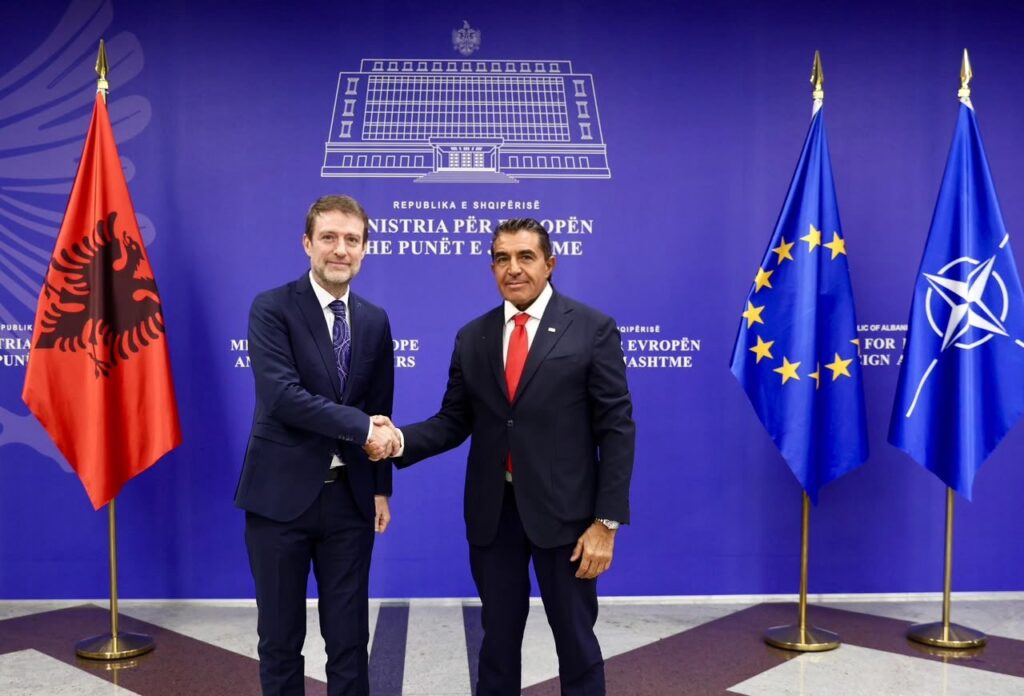
Paolo Zampolli, President Donald Trump’s Special Envoy for Global Partnerships, spent Monday in Tirana in a series of meetings with Albanian government officials, representatives of both major political parties and the leadership of the Bektashi Order, during what he repeatedly described as an informal courtesy visit.
The Italian-born American businessman and longtime Trump associate used the visit to promote closer economic ties between Albania and the United States, described Albania as an important American ally, welcomed its path toward European Union membership and commented publicly on Prime Minister Edi Rama’s proposal for a sovereign Bektashi state in Tirana.
At the Bektashi World Headquarters, where Zampolli attended ceremonies marking thirty-five years since the institution reopened after the fall of communism, he said the proposed state was an “excellent project” but that its creation was a decision for Albanians.
The visit also produced a separate announcement. At Continental Hospital, which operates within the Bektashi compound, the American biotechnology company ImmunityBio announced that it had signed a memorandum of understanding with the Bektashi Order. In a video message screened at the hospital, ImmunityBio president and chief executive Richard Adcock referred explicitly to the “future Bektashi Microstate”.
Zampolli was present for the hospital visit but did not sign or present the memorandum as an agreement of the United States government.
His appearance in Tirana came almost eighteen months after Trump appointed the longtime associate Special Envoy for Global Partnerships, a position without a country or regional assignment.
Trump announced the appointment on Truth Social on 11 March 2025. His portfolio has taken him across governments, businesses and international organisations, often with an emphasis on investment, commercial agreements and direct political relationships.
In Tirana, he presented the purpose of the visit in similarly broad terms.
“The message would be that Albania is a friend,” he told reporters. “You are allies. You are very important.”
He said the United States needed friends in different regions and valued longstanding relationships, and referred to the Albanian community in the United States. He also said relations between the two countries were already excellent and could become better.
“These are all informal meetings,” Zampolli said. “I came here to show respect and visit the country as a special envoy of the President.”
At the Bektashi headquarters, Zampolli joined Haxhi Dede Edmond Brahimaj, known as Baba Mondi, and representatives of Albania’s principal religious communities at events marking the thirty-fifth anniversary of the reopening of the headquarters in 1991, which the Order was observing with a jubilee conference.
Those attending included Bujar Spahiu, chairman of the Muslim Community of Albania; Archbishop Joan of the Orthodox Autocephalous Church of Albania; Catholic Archbishop Arjan Dodaj; and Erion Sylari of the Evangelical Fellowship.
The programme also included a ceremony in honour of Mother Teresa.
Zampolli spoke about his own Catholic family background, telling reporters that his mother was related to Pope Paul VI, born Giovanni Battista Montini, and that there were two saints in his family. He said being at the Bektashi headquarters on an occasion connected with Mother Teresa was personally moving.
He also praised Albania’s tradition of interfaith coexistence, a theme he linked repeatedly to Trump and Secretary of State Marco Rubio.
Zampolli then visited Continental Hospital inside the Bektashi complex, where the Order announced the agreement involving ImmunityBio.
ImmunityBio, listed on Nasdaq, is an American biotechnology company founded by physician and entrepreneur Patrick Soon-Shiong, who remains its executive chairman. The company develops immunotherapies and other cancer treatments.
The hospital announcement was delivered by video by Richard Adcock.
“Just moments ago, we signed a memorandum of understanding with the Bektashi Order and the future Bektashi Microstate,” Adcock said.
The announcement also identified Epitopoietic Research Corporation, or ERC-Belgium, a clinical-stage biotechnology company working on treatments for glioblastoma, as another participant in the wider medical initiative.
According to the account released around the event, the project envisages expanded access to advanced cancer treatment in Albania and the Balkans. Some of the commitments described by the organisers are intended to take effect only if the proposed sovereign Bektashi state is established.
The same material refers to the eventual creation of a Bektashi health and medicines authority and specifies that future authorisations under such an authority would not constitute approval by existing national regulators.
The full memorandum has not been made public.
Zampolli did not describe the memorandum as an American government agreement. Speaking after touring the hospital, he said he had received a general explanation of the project involving American partners and called what he had seen “excellent”.
He also spoke personally about cancer.
“I myself fought cancer for four years,” he said, explaining his interest in efforts to expand treatment.
In a longer exchange with reporters he referred to Trump administration policies promoting new treatments and the American “Right to Try” approach, enacted in federal law in 2018, which gives certain seriously ill patients access to investigational treatments under defined conditions.
The medical announcement occurred as the Bektashi Order continues to pursue Rama’s proposal for the creation of a sovereign entity centred on its headquarters in Tirana.
Rama first announced the idea publicly in September 2024, in remarks to The New York Times and the following day from the rostrum of the United Nations General Assembly, presenting it as a small sovereign home for the Bektashi Order modelled in some respects on the Vatican and intended to promote Albania’s tradition of religious tolerance.
No Bektashi state currently exists. Establishing one would require major political, constitutional and legal decisions by Albania and, for full international statehood, recognition beyond Albania.
Zampolli was asked about the proposal twice during Monday’s visit.
In one exchange he called it “an excellent project” but immediately added that the decision belonged to Albanians.
He said he had come to learn about what the Bektashi community represented and described the project as potentially providing a distinctive identity, before returning to the principle of religious coexistence.
Later, at the Bektashi headquarters, he was asked again.
“I heard the Prime Minister speak. I heard His Holiness,” Zampolli said. “Your people decide or will decide.”
He said he believed the international community would respect the decision of the Albanian people and initially added that he thought Albanians wanted the project.
A reporter interrupted to point out that the Albanian people had not expressed such a view.
“Ah, all right,” Zampolli replied. He said he had heard some people speak, “but perhaps not the people as a whole”, and concluded that the people therefore had to express themselves.
The remarks put a Trump-appointed presidential envoy publicly on the record on the proposed state. They did not amount to formal United States recognition of the proposed entity, and Zampolli repeatedly placed the decision on its creation with Albanians.
His political meetings extended across Albania’s governing and opposition parties.
At the Assembly, Socialist parliamentary group chairman Taulant Balla received Zampolli and later said the discussion had covered Albania-US relations, Albania’s role in regional stability and the NATO summit that Tirana is due to host next year.
Balla also said Zampolli had spoken positively about Albania’s participation, through Rama, in Trump’s Board of Peace.
“Albania is a model of the role and partnerships for peace and stability,” Balla wrote after the meeting, describing the country’s interfaith coexistence as a source of national cohesion.
Zampolli also met a Democratic Party delegation consisting of parliamentary group chairman Gazment Bardhi, secretary general Flamur Noka and Jorida Tabaku, chair of the parliamentary Human Rights Committee.
The Democratic Party used the meeting to raise a series of domestic political and institutional concerns.
According to the Democratic Party’s statement, its representatives raised organised crime, corruption, the concentration of political power, the independence of the justice system, election standards and what the party calls the “Soros agenda”.
The party said it told Zampolli that organised crime and corruption were damaging the investment climate and international confidence in Albania, and argued that the country needed stronger institutional accountability, separation of powers and electoral integrity.
The Democratic Party also said Zampolli expressed readiness for close cooperation with the opposition and to help Albania advance its democratic processes. That formulation came from the party’s account of the meeting; no separate American readout of the discussion had been published by Tuesday morning.
Democratic Party chairman Sali Berisha was in the United States and did not take part.
Zampolli subsequently met Foreign Minister Ferit Hoxha.
Unlike the political statements surrounding the Bektashi project, Hoxha’s own account of that meeting, posted on X, placed economics at the centre.
Hoxha said the two had reaffirmed the “special bond” between Albania and the United States and a shared determination to deepen and expand the strategic partnership, naming trade, economic engagement and increased American investment in Albania as the fields for cooperation.
He said the transatlantic relationship remained the cornerstone of Albania’s security and described new partnerships as a way of translating the political relationship into concrete benefits for both countries.
Zampolli also met Klodiana Spahiu, newly decreed Minister of Health and Social Protection, whose appointment was awaiting a vote in Parliament.
Spahiu said the meeting covered the Albania-US strategic relationship and potential cooperation in several fields. She also pointed to next year’s NATO summit in Albania as evidence of the country’s growing role within the Alliance.
Argumentum, which carried the English-language account of the Bektashi ceremony, reported that his programme also included the Minister of Economy and Innovation. No readout of that meeting has been published.
Asked separately about NATO, Zampolli said the organisation was necessary but made clear that NATO was not his own portfolio.
“NATO is an organisation that we need,” he said.
He also said Washington welcomed Albania’s membership of the European Union.
The visit took place during an unusual transition at the US Embassy in Tirana.
Zampolli told reporters that Washington had appointed what he called an excellent new ambassador who had not yet arrived in Albania.
He was referring to retired US Army Lieutenant General Eric Wendt.
Trump formally nominated Wendt on 13 April. After a Senate Foreign Relations Committee hearing on 20 May and committee approval on 4 June by 19 votes to 3, the Senate confirmed him on 7 August as part of a package of nominees approved by 51 votes to 47.
The US Embassy in Tirana welcomed the confirmation, saying Wendt would champion Trump’s vision for “shared security, a stronger NATO, and fair deals for U.S. businesses”.
He had not yet taken up the post when Zampolli arrived.
The embassy has been led by chargés d’affaires since Ambassador Yuri Kim left Albania in June 2023.
Zampolli’s own route into American diplomacy is markedly different from Wendt’s.
Born in Milan in 1970, he made his name in New York in the 1990s in the modelling business, founding his own agency and working as a partner at Metropolitan Models. He became part of the social and business circles around Trump long before Trump entered politics.
Zampolli is widely credited with introducing Trump to Melania Knauss, then a Slovenian model, at a New York Fashion Week party in 1998. Melania later became Trump’s wife and First Lady.
Zampolli subsequently moved into property and other businesses and maintained his relationship with Trump.
His diplomatic experience before joining the Trump administration came partly through the Caribbean state of Dominica, which he represented at the United Nations in a succession of roles, including as ambassador. Trump selected him in December 2020 for the Board of Trustees of the John F. Kennedy Center for the Performing Arts in Washington.
His appointment in March 2025 brought those strands together.
“I am pleased to announce that I am appointing Paolo Zampolli as Special Envoy for Global Partnerships,” Trump wrote. “With his extensive experience working with the United Nations, the Kennedy Center, and various International initiatives, Paolo will help us advance America’s Interests on the Global stage.”
No detailed public mandate for the position sets out a geographic or sectoral remit. Since his appointment Zampolli has appeared in a succession of international settings combining political access with economic and commercial diplomacy, from the Gulf and Central Asia to Romania and the Vatican, at signings and in delegations alongside heads of state and finance ministers. Earlier this year he proposed to FIFA that Italy replace Iran at the World Cup, a suggestion the Financial Times reported as part of an effort to repair relations between Trump and Italian Prime Minister Giorgia Meloni.
He moved in the course of the visit between a religious institution, a biotechnology project, the government, the governing parliamentary group and the opposition, while describing all of the meetings as informal and returning repeatedly to investment, partnerships and personal relationships.
He also spoke openly about his familiarity with Rama, saying he had met the Prime Minister several times in Washington and at international gatherings. The two did not meet in Tirana on Monday. Zampolli said he understood Rama had travelled south as Albania confronted wildfires.
At one point, explaining why the Prime Minister was away, he put it more simply:
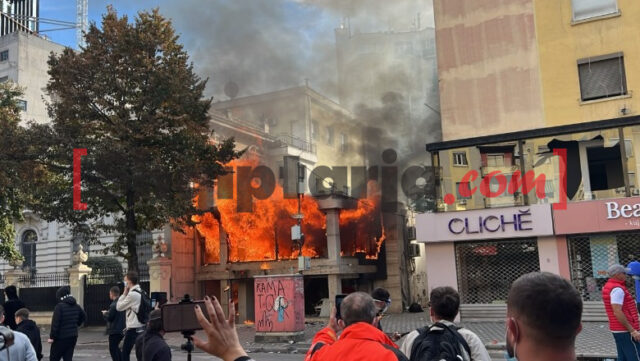
“Albania is in flames.”