Kos asked the Student List for strategic alignment on Wednesday. On Thursday its candidate told AFP that no sanctions on Russia is written into the programme, and the Commission’s own report explains why that costs Belgrade nothing.
By Ngadhnjim Brovina (Regional Affairs Desk)
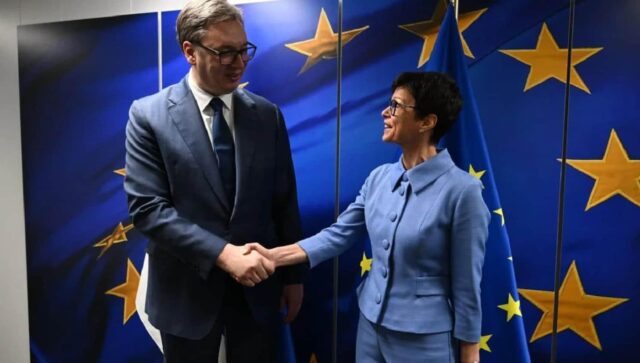
On Monday afternoon Marta Kos received four representatives of the Student List in Brussels, at her invitation, while the Commission was finalising its annual assessment of Serbia. The Commission declined to confirm who came. On Wednesday the report was published, and Kos told the European Parliament’s foreign affairs committee what she had taken from the meeting: “The protesters in Serbia want the same as the European Union is asking from Serbia, meaning anti-corruption, free and independent media, free and independent judiciary. Good neighbourly relations and, of course, also strategic alignment with the European Union.” On Thursday RT Balkan published the list’s answer, given to AFP, under a headline Kos could have written herself: our position on sanctions against Russia is very clear.
The speaker was Mirjana Nikolić, rector of the University of Arts and ninetieth on the list. The students wrote their opposition to sanctions on Russia into the programme, she said; it is set out there very explicitly. Europe remains the strategic goal because Serbia has a benefit from it, and the previous government, she added, absolutely worked and opened chapters. Small countries must have a strategy.
The report had graded that previous government the day before. Serbia “did not make any substantive progress in accession negotiations”. Twenty-two of thirty-five chapters have been opened since 2014, none since December 2021. Alignment with the common foreign and security policy stood at 63 per cent on 1 September, down from 67 per cent a year earlier. The only movement came from retroactive alignment with Council decisions on Russian individuals. The students’ programme of 30 September closes that door in writing: Serbia will keep its principled position of not imposing restrictive measures on the Russian Federation. The Commission’s recommendation for the coming year is to “avoid actions and statements that go against EU positions”. The statement preceded the government.
Her distinction between harmonisation and alignment is in the report too: “Serbia aligned with the EU on technical issues, but not on political issues (e.g. Russia, Ukraine, China, Iran, DPRK).” The Commission’s name for that pattern is “questions about Serbia’s strategic orientation”. Kos’s phrase on Wednesday was strategic alignment. Nikolić’s word is strategy.
The press release says “political choices on security and defence” directly shape the speed of each partner’s accession. Four countries received roadmaps on Wednesday; Serbia received conditions, written for a government the report never assessed: its period closed on 1 September and, as Euronews put it, the report “does not reflect the result”. The first condition was answered within a day by the majority the Commission said had been given “a strong mandate for reforms”. Monday’s talks, Euronews reports, “centred on domestic affairs rather than on repairing ties with the EU”. The four spoke of the rule of law and democracy; the Commissioner added strategic alignment herself, in Parliament, two days later. The list has now said what it thinks of the addition.
The annex records EUR 1,014.4 million under IPA, an indicative EUR 1.586 billion under the Reform and Growth Facility and EUR 167.6 million already released, all to a government aligned at 63 per cent. The cost charged for non-alignment occupies one sentence: Serbia does not receive assistance under the European Peace Facility. Nikolić’s remark that Serbia has a benefit from Europe is a reading of that record, and an accurate one. The benefit never carried the condition. The same package opens a framework for gradual integration “upon conditions”. Either the conditions apply to the list Brussels congratulated on election night and received on Monday, or the new framework opens with the exception the old one carried.
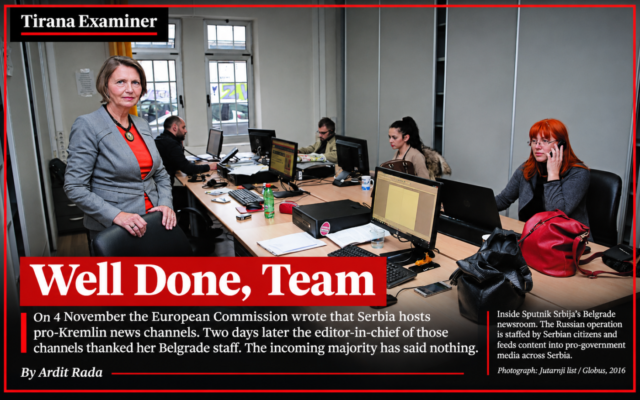
RT Balkan appears in the report as evidence of “a permissive environment for Kremlin-aligned narratives”. The recommendation to close the space for foreign information manipulation is addressed to the next government, whose candidate’s interview the channel republished, linked to its own interview with Vladan Kuzmanović of the same list. Ilija Srdanović, first on the list, had said relations with Russia would be a dialogue within the movement; the channel prints his hedge beneath Jovo Bakić, Kuzmanović, Radomir Saičić and Nikolić, and the hedge loses. The Commission could not say which four it met on Monday. The ninetieth name on the list spoke for all of them on Thursday.
Kos asked for two things on Wednesday, good neighbourly relations and strategic alignment. Saičić answered the first on RTS within days of the vote, calling Kosovo occupied territory, as this publication reported; Edi Rama told Euronews on Tuesday that the new government is unlikely to recognise Kosovo. Nikolić answered the second within a day of the hearing. Both answers were very clear. What Brussels does about the second will tell Pristina what it intends to do about the first.