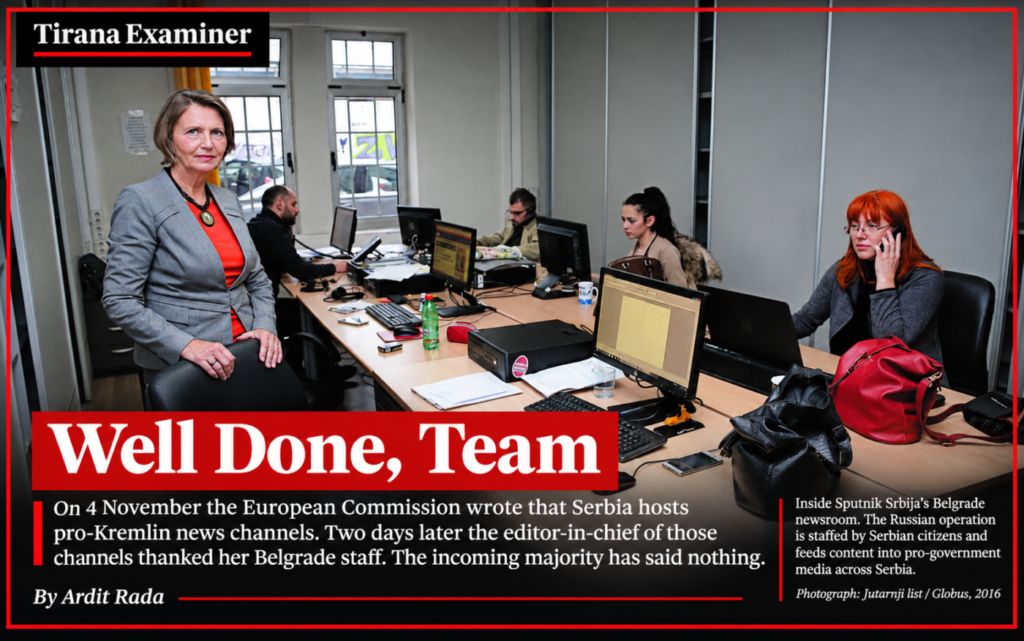
On 4 November the European Commission wrote that Serbia hosts pro-Kremlin news channels. Two days later the editor-in-chief of those channels thanked her Belgrade staff. The incoming majority has said nothing.
By Ardit Rada (Tirana)
At 18:45 on 6 November, Margarita Simonyan posted a long quotation on her Telegram channel. It came from Onet, a Polish news portal, and it described what Russia had built in Serbia’s media since 2014: a Sputnik radio service, later an RT portal, both staffed by Serbs rather than Russians, both feeding content into pro-government tabloids until the Russian version of events became the common one. The passage, as she reproduced it, ended on a verdict. Roughly twelve years of lies had turned a society that was once clearly pro-Western into one that was becoming more and more pro-Russian.
Simonyan is editor-in-chief of RT and of Rossiya Segodnya, the state holding that owns Sputnik. She added four words of her own: “Well done, team.” By the time the post was captured it had 35,400 views. She disputed nothing in the Polish text, including the word lies.
Sputnik Srbija reported the post at 19:19 the same evening, under a headline saying that Simonyan had praised Sputnik and RT. Its readers were given Onet’s thesis with the verdict removed. “Twelve years of lies” became “approximately twelve years of operation of Russian media”. The “pro-government tabloids” that had begun citing Sputnik became “the media”. The sentence recording that not a single Russian works at RT’s Serbian operation was dropped, as was the sentence on its editorial team’s contacts with government-financed outlets. One phrase survived in quotation marks: Onet’s description of the whole enterprise as “influence operations”. The desk that had just been congratulated kept the category, cut the charge, and had the edited version online within thirty-four minutes.
Both outlets are on the European Union’s sanctions list. Council Regulation 2022/350 of 1 March 2022 suspended the broadcasting of RT’s main services and of Sputnik across the Union, by cable, satellite, internet and app, until Russia ends its war on Ukraine. RT Balkan, the Belgrade portal, was added by name on 23 June 2023 in the eleventh package. Simonyan herself has been under an EU asset freeze and travel ban since 23 February 2022. Montenegro, North Macedonia and Albania aligned with these measures; Montenegro took RT and Sputnik off air in 2022. Serbia did not.
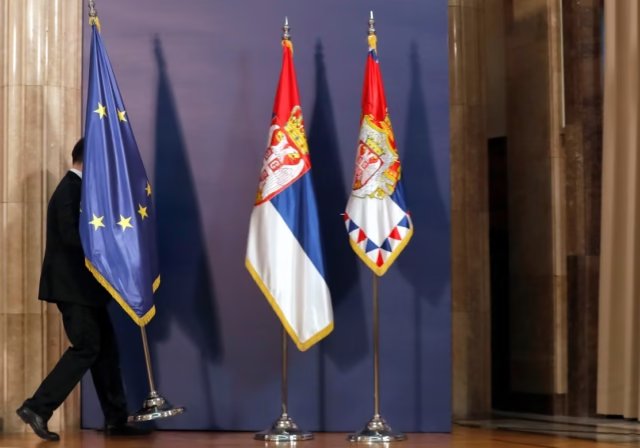
Two days before Simonyan’s post, on 4 November, the Commission published its Serbia 2026 Report. The chapter on foreign and security policy puts Serbia’s alignment with EU sanctions decisions at 63 percent as of 1 September, down from 67 a year earlier. It records that Serbia has not aligned with the restrictive measures against Russia and Belarus, that it keeps flying to Moscow, Saint Petersburg, Kazan and Nizhny Novgorod, and that it continues to “host pro-Kremlin news channels”. It finds no progress on foreign information manipulation and interference. Among the recommendations for the coming year, it asks Serbia to make alignment, including with restrictive measures, a priority, and to prevent Serbian territory and Serbian citizens from being used by third countries for hybrid operations. The recommendation is addressed to Serbia; the report notes the result of the 25 October election, and the obligation passes to the Student List with the government. The Commission’s description of the problem is Onet’s: a third country’s operation, on Serbian territory, run by Serbian citizens. Simonyan’s post names the third country.
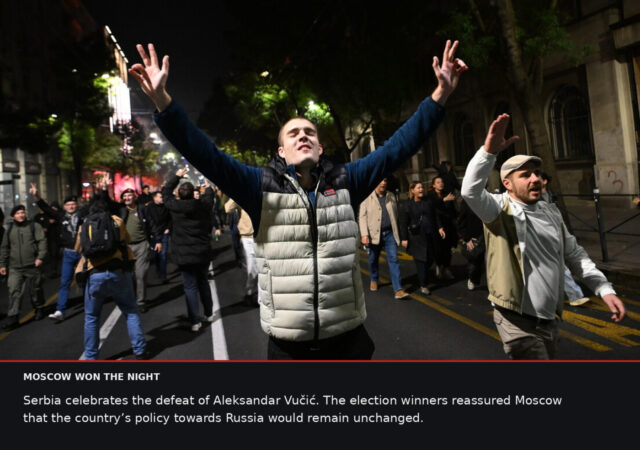
The Student List won 140 of 250 seats. On 27 October it sent an open letter to the management of RTS, the REM Council and the National Assembly demanding the resignation of the public broadcaster’s general director, his deputy and the editors of its news programme, and a regulator that does its job. Russian state media appear nowhere in the letter. On Russia, its candidate Mirjana Nikolić told AFP the list would not impose sanctions. The sociologist Jovo Bakić, interviewed on RT Balkan the morning after the vote, said there would be no sanctions and no change. The list’s people treat RT Balkan and Sputnik Srbija as part of the Serbian media they speak to. Nothing in its twenty-point programme touches them.
The Assembly has not yet been constituted and no government exists to take the decision. On the channels the Commission describes, the list has said nothing and asked nothing, and its people have given them interviews. Reporters Without Borders described RT’s Belgrade office in 2024 as the place where Kremlin narratives are adapted before distribution across south-eastern Europe. The schedule on the Sputnik Srbija page that carried Simonyan’s praise lists, at 21:00, an interview titled “Kosovo and Metohija: the Golgotha of Property”.
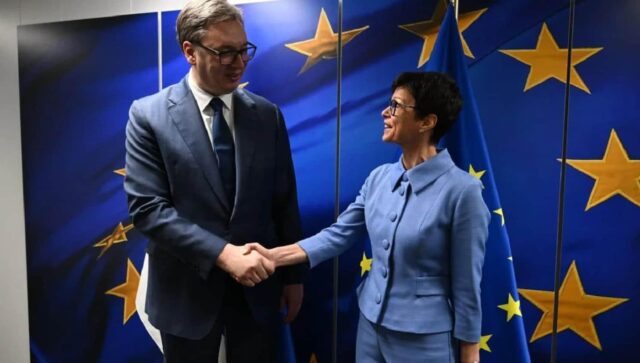
Ursula von der Leyen, Friedrich Merz and Marta Kos congratulated the list within a day of the vote and spoke of an open door. Nine days later the Commission wrote the sentence about pro-Kremlin channels, and Kos told the European Parliament’s foreign affairs committee that strategic alignment is the condition for progress. That condition now applies to a government Brussels welcomed before it had said a word on Russia, and the Commission’s own report has told it where to look. For four years Brussels explained its tolerance of Vučić’s non-alignment by stability. A majority it has itself called democratic takes that explanation away.
On the evening Simonyan thanked her team, RT Balkan and Sputnik Srbija were publishing from Belgrade, as they are tonight. The Commission has written down what they are. The incoming majority has written down what it wants changed in Serbian media, and they are not in it. Whether the channels continue operating in Serbia is not in question. What Brussels does with a finding it has already made is.