The opposition leader crossed the ocean he had been told he would never cross again. The community that received him is not one community, and part of it has learned to act without him.
By Klea Ukaj, US Bureau · Clinton Township, Michigan
The Austrian Airlines flight from Vienna touched down at John F. Kennedy at five past eight on the evening of Friday 4 September. By half past, Sali Berisha and the people travelling with him were at passport control. Beqir Sina, the New York journalist who was waiting in the arrivals hall, reported that the first greeting Berisha received on American soil came from a Customs and Border Protection officer, and gave the officer’s words as “Welcome, Mr. Berisha!” In the hall itself, by his count, several dozen people were waiting with flowers.
We take that from Sina because his is the only account of the arrival filed by anyone who was there, and because Sina is a man of the community: born in an internment camp at Savër near Lushnja, raised in the Bronx, a reporter of Albanian America for thirty years. He is also, by his own published commentary, a supporter of the man he was waiting for. Both things are true, and both belong in the record.
What Berisha entered on is worth stating precisely, since the argument about it has already begun. In May 2021 the Biden administration designated him and his wife, son and daughter under Section 7031(c) of the State Department’s appropriations law, citing significant corruption while in office. In June this year the same department told Reuters it had issued waivers for several such designations because granting them serves a compelling national interest, and declined to name anyone. A waiver of that kind permits entry without requiring the department to rescind the underlying finding, and no rescission has been published. We wrote as much in June, and nothing since has required us to amend it. The 2021 designation is still on the department’s website. So is Berisha, in New Jersey and now in Texas.
Whether the visa in his passport runs for five years, as the Democratic Party’s deputy chairman Belind Këllici said before departure, or six, as Sina reported from the airport, we cannot say. Sina writes that the visa form itself gives “compelling national interest” as the department’s reason.
Two rooms in Garfield
The Sunday meeting was announced for the Bergen Performing Arts Center in Englewood and moved, days before, to the Venetian, a banquet hall in Garfield. Këllici said demand forced the move and called it the largest event an Albanian politician had ever held in the United States. Party supporters said the original venue had been pressured. We have no evidence for the second claim and have not been able to test the first.
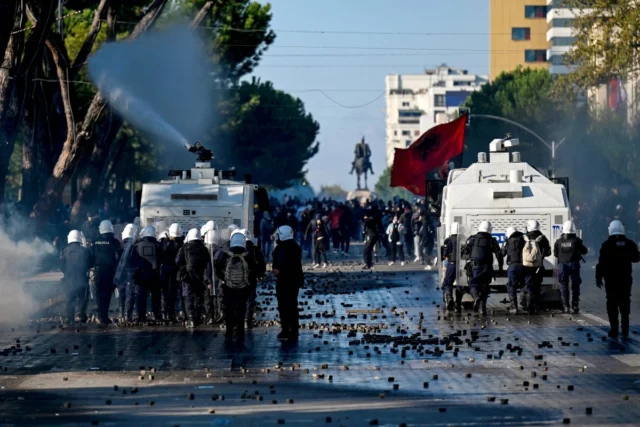
Inside, the chant was “Rama në burg.” Berisha called the community “the good fortune of the Albanian nation,” said the day was one many had thought impossible, and gave his account of the five years: an injustice that “did not come from the United States” but from “the anti freedom and anti national agendas of what President Trump himself has called the extreme left.” He thanked the president and Secretary of State Marco Rubio. Then the line that travelled: “Those who showed us the grass ended up unemployed. Those who signed my ban are today non grata in their own country. Those who prepared the frauds against me in Albania are behind bars.” The first two clauses name, without naming, Yuri Kim and Antony Blinken.
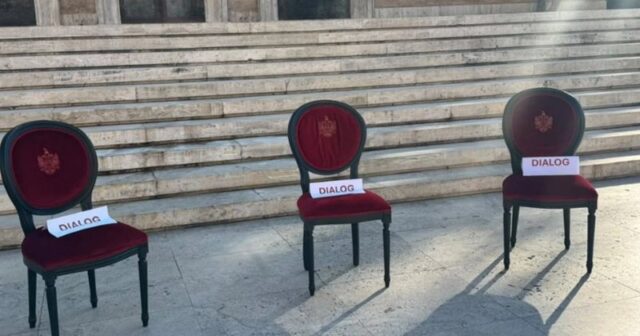
Outside, a smaller group chanted “Berisha në burg” and “the doctor of Enver Hoxha.” Their placards, photographed by Shqiptarja, listed the 2021 designation, the lobbying contract, and Gërdec. Shqiptarja also published footage of empty chairs at the back of the hall.
The hall and the pavement are the same community and the same afternoon. That much everyone in Tirana already knows; Albanian politics has reproduced itself abroad for thirty years. What Tirana does not know is what happened in Texas before Berisha got there.
Three restaurant owners in Collin County
Keith Self represents the third congressional district of Texas: McKinney, Plano, Wylie, the northern suburbs of Dallas. He is a retired Army lieutenant colonel whose 25 years of service included Joint Staff postings at European Command and at NATO’s military headquarters in Belgium. He chairs the House Foreign Affairs subcommittee on Europe. In December he held a hearing on the Western Balkans. In May he flew to Kosovo and the Preshevo Valley.
None of that happened because of Sali Berisha, or because of any party in Tirana.
It happened because three Albanian American men who own restaurants in Self’s district, Gezim Rushiti, Gino Mulliqi and Doc Vranici, wrote to their congressman. The National Albanian Registry, which profiled them in May, names the three as founding members of an organisation called Albanians for America and dates the approach to 2024; in August of that year they brought Self to Vatra in New York. Dielli’s account is that the contact led to Chairman Brian Mast introducing Balkans language in the House; we have not traced the legislative text ourselves. In February the Congressional Budget Office scored a bill called the Preshevo Valley Discrimination Assessment Act. In May, by Illyria’s account, the organisation hosted Self at a luncheon and a dinner in Chicago. The same month, by its own announcements as carried in the Kosovo press, it sent a delegation through the offices of Senators Ted Cruz and Andy Kim and five House members, and coordinated Self’s trip to Prishtina and Preshevo with Congressman Suhas Subramanyam, a Democrat from Virginia.
The same organisation hosted Albania’s president Bajram Begaj in Dallas in April and met him again in Tirana in August. We found no institutional link between it and either Albania’s Democratic Party or its Socialist Party. What we found was three constituents doing what American constituents do, with a persistence the older diaspora capitals never quite managed.
So when Berisha and Fatmir Mediu sat down with Self this week, they sat down with the congressman at the centre of a network the Albanian community had built on its own account, across party lines, and without them. The readout, published by the Democratic Party and carried by Syri, says the two men discussed drug trafficking, corruption, the manipulation of elections and the justice system; that Berisha thanked Self for his statement on the honours Serbia gave Ratko Mladić, for his interest in Preshevo and for his support of Kosovo in NATO; and that a technical government on the North Macedonian model was proposed as the remedy for elections that, in the readout’s phrasing, “it was established” neither Aleksandar Vučić in Belgrade nor Edi Rama in Tirana allows to be free. The passive voice there is doing work. We have no account of the meeting from Self’s office, from the committee, or from anyone outside Berisha’s delegation, and until we do, the account is Berisha’s. Whether Albanians for America arranged the meeting we do not know. Mulliqi, Vranici and Rushiti know, and we have asked.
What can be said without their answer is this. Berisha thanked Self for Preshevo and for Kosovo in NATO before he mentioned Rama. He was speaking to Self’s file, and Self’s file was written in Collin County.
The archipelago
Albanian America is spoken of in Tirana as if it were a constituency. It is closer to an archipelago. Vatra was founded in Boston in 1912 with Fan Noli as its secretary and Faik Konica among the incorporators; its newspaper, Dielli, is three years older. The Bronx built its own institutions later. Detroit and its suburbs, where this bureau sits, hold one of the largest Kosovar communities in the country, and its politics has run through Prishtina and the Preshevo Valley for as long as we have covered it. The arrivals from Albania itself since the 1990s carry the country’s party divisions with them. Dallas is on none of the old maps. The Census counts about 230,000 people of Albanian ancestry; the National Albanian Registry, a community project, argues the true number is nearer a million. The two figures do not measure the same thing and we do not adjudicate between them. What they share is that no one in Tirana has ever counted this community either.
These islands do not vote the same way about Albania because most of them do not vote about Albania at all. Vatra, whose members filled part of the Garfield hall, publicly challenged the 2021 designation when it was imposed. Its editor, Sokol Paja, filed from Garfield that the visit “appears to blur the narrative of the non grata.” Harry Bajraktari, who was in New York and New Jersey both, wrote that Berisha is “fighting for Albania in an unjust battle.” The pavement outside is the American echo of a chant that Reuters recorded in Tirana in June and that was still audible on the 93rd night of the capital’s protests: “Rama në burg, Berisha në burg.” And Collin County belongs to neither.
The convention, and the photograph
The Republican National Committee’s midterm convention in Dallas is real and unusual: the first of its kind, permitted by a rule change at the committee’s January meeting, two evening sessions on 9 and 10 September, Vice President Vance one night and the president closing the other. Berisha is going. The document that places him there is a letter of 7 August from the International Democracy Union, the association of centre right parties of which his own is a member, confirming his place in the IDU delegation; the IDU’s membership page lists him as the Albanian party’s chairman. He said before leaving Tirana that the delegation runs to about thirty party leaders and that he holds a second invitation “from an American institute connected with this conference.” We have not identified the institute.
Syri has written for three days that Berisha is in America “at the invitation of President Donald Trump’s Republican Party.” The only document anyone has shown is the IDU’s. Berisha’s own description, at his 29 August press conference, was the more modest one: an IDU delegation, a second invitation, no meetings booked, passport still at the embassy. Asked at Rinas whether he would meet the president, he laughed and said no.
For readers in Tirana who will see photographs from the American Airlines Center on Thursday, one piece of American context. A convention floor is not a bilateral. The Wall Street Journal, citing the Republican National Committee’s own invitation, has reported that fundraising events held during the convention offer donors a roundtable with the president for 250,000 dollars a seat and a photograph with him for 88,600. We do not suggest any photograph of Berisha will be obtained that way. We note only that in Dallas this week a photograph with the president is, among other things, a line item, and that a photograph is evidence of a photograph.
What the visit cost, and who paid
The Justice Department’s foreign agent registry shows Continental Strategy of Miami registered in April 2025 to represent the Democratic Party of Albania, Flamur Noka as its principal, at a retainer of 250,000 dollars a month over an anticipated two years. That is the six million on the Garfield placard. The engagement letter described establishing relationships in the executive and legislative branches. A paper filed under the same registration in July 2025 argued that the 2021 designation was political and should be lifted. Eleven months later it was waived.
That is a chain, not a proof. No document says the waiver was granted because of the paper. Berisha himself, outside parliament on 18 June, put it this way to reporters: “They lobbied for Sali Berisha, because the procedure is lobbying. I did not lobby the Biden administration. There is no other procedure there except lobbying. The only sanction I had was the visa.” Asked who had paid, he answered: “a foundation which helps the Democratic Party and has undertaken to defend the Democratic Party’s cause.” He did not name it and would not say what it cost. What the record establishes is sequence: the money, the argument, the waiver, the visa, the flight. Readers may draw their own lines between the points.
The party’s foreign secretary, Enri Çeno, drew one of his own on Syri’s morning programme on Sunday, and it is the most candid thing anyone in the delegation has said. The midterm elections, he explained, are expected to be close in both chambers, with some races extremely tight, “such as the Senate race in the state of Michigan, where we as Albanians have a community that can influence and directly steer that final result,” whether it goes to the Democrats or the Republicans. He went on to say that under the party’s recent statutory changes the diaspora now holds a quota inside its leadership structures, and that meetings like Sunday’s are meant to recruit candidates from America for the next Albanian elections.
We sit in Michigan. We have not seen anyone ask the Albanian Americans of Macomb and Oakland counties whether they wish to steer anything for a party in Tirana, or to be recruited by one. The community Çeno spoke of is the same community that, without any party’s help, put a Texas congressman on a plane to Preshevo.
Access, not exoneration
The Tirana press has divided on a question the diaspora press answered years ago. Çim Peka, on Syri, wrote that questioning a Washington decision was never anti American but “the most American thing you can do.” Ervin Salianji, from the other side of the opposition, wrote that Berisha “can travel to the United States but cannot travel politically in Albania.” Both are Tirana arguments about Tirana.
Illyria, the Bronx newspaper, asked the State Department in May 2021 why it had acted and was told the department possessed credible information and would not engage with people it considered corrupt. Five years later the same paper reported the June waiver with a caution most of the Albanian press did not manage: it recorded that Berisha had not said who informed him, attributed the claim that the accusations had collapsed to the party’s communications director rather than to Washington, and reminded readers of the trial still under way in Tirana. Illyria has not, as of this writing, published anything on the September visit.
That silence is not a verdict. Neither is the noise. Here is what the week has established. Berisha is no longer excluded from the United States. The administration used a waiver authority in a way that benefited him and has not said why. He was received by the international network of centre right parties as a member in good standing. He met a subcommittee chairman with a real Balkans file. He filled a hall in Garfield with people who had waited five years for it, and he was picketed by people who wished he had stayed away. He has not met, and did not expect to meet, anyone in the executive branch. No American institution has adopted his demand for a technical government. The entry restriction of 2021 has been waived; the finding behind it has not been publicly withdrawn.
Access is not exoneration. That formulation is ours, and it will hold until an American official in a position to know says otherwise.
There is one more thing the week established, and it is the one our readers in Tirana will find least comfortable. Rushiti, Mulliqi and Vranici got a congressman to Preshevo without a lobbying contract, without a party, and without asking anyone in Albania for permission. Sina, whose politics are not in doubt, filed the only account of the arrival. Illyria, whose caution is not in doubt, kept a 2021 quotation on file for five years so that it could be set beside the 2026 one. The Michigan community that Çeno would like to steer has been organising its own naturalisation ceremonies and placing its own young people in congressional offices for two years.
Albanian America is not a resource. It is a constituency, several of them, and they have started to act like one. Sali Berisha flew across the ocean to thank a diaspora. What he found was an electorate.