The lightest charge in the procurement chapter is carrying the heaviest file in SPAK’s building. A Legal Desk reading of the Balluku case.
By Renada Bici, Legal Desk
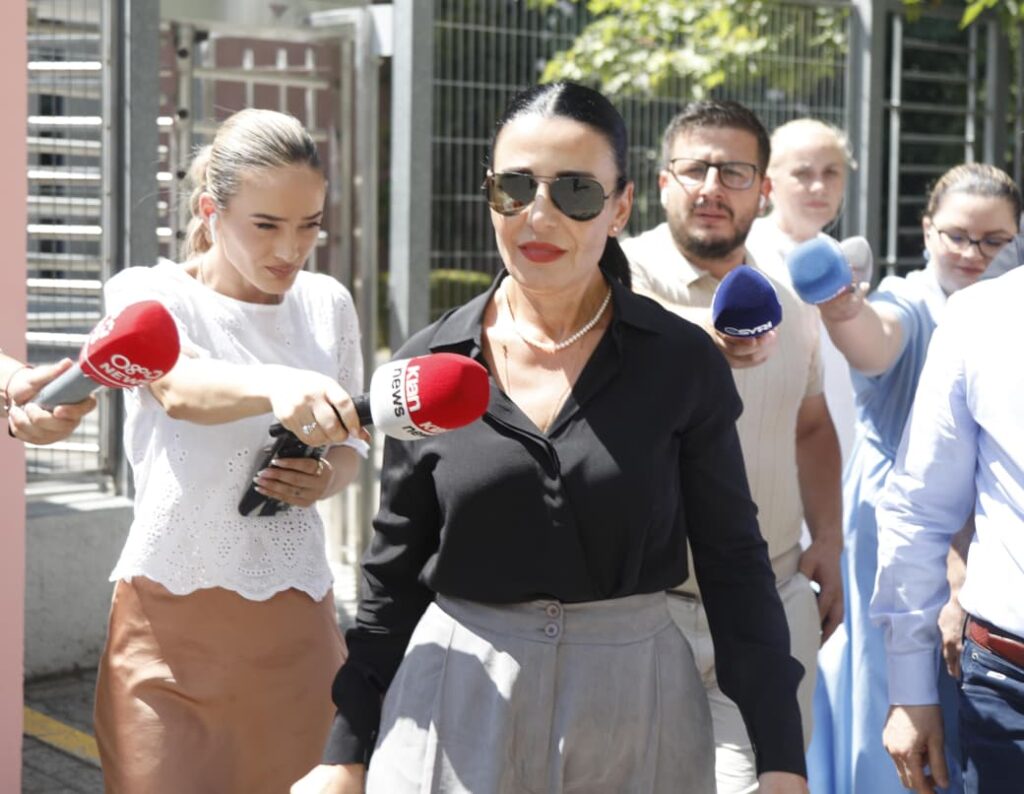
Belinda Balluku was summoned to the Special Prosecution for ten on Friday morning and arrived at two in the afternoon, with her lawyer, past the small crowd on Rruga Jordan Misja that the police had tried and failed to clear, standing on a pavement not yet being an offense. She said nothing to the cameras and left an indictee in six more tenders. The prosecution then issued a statement explaining why she had been called: to be notified of the charge, to be questioned about it, to receive other procedural acts. The statement did not linger on what the charge is, and neither did the coverage. It should be lingered on, because in this file the charge is nearly everything.
All eight procedures now attached to the former deputy prime minister, the Llogara tunnel and the seven lots of Tirana’s Great Ring Road, rest on one article of the Criminal Code. Article 258 punishes a person entrusted with state functions or public service who acts contrary to the legal rules governing free participation and equality in tenders and public auctions, creating unjust advantages for third parties. Read the elements slowly, because it is what they omit that defines the offense. There is no element of gain. There is no element of agreement with the advantaged bidder. There is no element of purpose at all. The offense is complete the moment the rules of the procedure are bent in someone’s favor, whoever that someone is and whatever the official had in mind. The ceiling is three years’ imprisonment, which places it at the floor of the procurement chapter and inside the band our courts resolve, as a matter of documented practice, with suspended sentences and community service. The anti-corruption courts’ own record says so, from the Divjaka municipal officials to the road-authority defendants: a year reduced to eight months, suspended, one hundred and twenty hours of public work.
Now record what is not in the file. There is no corruption count. There is no laundering count. The only corruption allegation attached to Belinda Balluku lives in a separate strand, and its address is instructive. It does not concern the ministry or its six hundred million euros of roads. It concerns two tenders from her years as director of Albcontrol, a different job in a different decade, where a villa in Dhërmi stands sequestered and where she is investigated but not indicted. A prosecution ordinarily travels from an offense toward whoever committed it. The record here does not disclose the order of anyone’s intentions, but it discloses the order of results, and the order of results runs the other way. The investigation reached the deputy prime minister’s flagship works and produced a procedural offense with a three-year ceiling. To produce a corruption allegation, it had to leave the ministry, leave the decade, and go back to a state enterprise she once ran. That is the shape of an investigation that begins with a defendant and is still looking for its offense. In the file that produced Friday’s summons, the file to which the SPAK chief has assigned two prosecutors and nine investigators and which he describes as the institution’s highest priority, the state does not allege that Belinda Balluku took anything. It alleges that the procedures were not equal.
Set that charge on a map of the legal orders Albania is negotiating to join, and it changes character. The continental mainstream does not treat a violation of procurement equality as a crime. It treats it as administrative illegality, policed by review chambers and administrative courts, remedied by annulment of the award, exclusion of the official, fines on the contracting authority, and damages for the losing bidder. Germany sends the aggrieved bidder to the procurement chambers; its criminal law enters only for bid-rigging agreements among bidders or for actual bribery and breach of trust. The two most cited exceptions have spent the last decade in retreat from their own texts. France’s favoritisme, the nearest relative of our Article 258, has been the object of successive official reform recommendations urging that it be confined to knowing and serious violations, precisely because it criminalized conduct that administrative law already policed. Italy went further and in 2024 abolished abuso d’ufficio outright, on the stated ground that a broad offense of official misconduct with a light intent requirement had become an instrument for governing the administration through fear of the file. The European Commission objected to the Italian reform in writing, worried that decriminalization weakened the anti-corruption framework of a founding member state.
Those two facts sit awkwardly together, and the awkwardness should be named without theatrics. When Rome removes an intent-light offense from its code, Brussels protests. When Tirana builds its largest prosecution on one, Brussels reads it as the rule of law at work. The strongest argument on the prosecution’s side of the ledger reconciles them like this. Albania criminalized what Germany administers because Albania’s administrative enforcement was never allowed to work. The review bodies were furniture, and the drafters of the nineties reached past them for the prosecutor because there was no one else to reach for. That argument is true, and it is an argument about institutional capacity, not about the offense. It explains why Article 258 exists. It does not explain why Article 258, rather than the corruption articles that sit above it, should be carrying the heaviest institutional commitment in SPAK’s building.
That concession has to be defeated, not merely wounded. An offense created as a substitute inherits the proportions of what it substitutes for. If Article 258 exists because the procurement chambers did not, then it exists to deliver by criminal means what a functioning chamber would have delivered by administrative ones: the annulment of a rigged award, the exclusion of a compromised official, a consequence measured to a procedure. Nothing in that rationale converts a stand-in for administrative review into a warrant for the full coercive apparatus of criminal procedure aimed at a person. The weakness of one institution does not enlarge the proportionality owed by another. If anything it narrows it, because a prosecutor doing a review body’s work owes the public a review body’s restraint; otherwise he is not substituting for the missing institution but replacing it with something the drafters never designed. And the rationale carries an expiry date, which has passed. The furniture of the nineties has been succeeded by a Public Procurement Commission, by administrative courts, by an accession process whose own procurement chapter demands administrative remedies that work. A justification borrowed from an institutional landscape that no longer exists cannot underwrite the most intensive prosecution in the one that does. The arrangement also feeds itself: every year the prosecutor performs the review body’s function is a year the Republic is excused from building one.
And Albania’s own courts have begun to draw the same line. In the file over the nineteen-million-euro Skërfica tunnel tender on the Kardhiq to Delvinë road, the special first-instance court acquitted several road-authority officials last July on the ground the procedure code reserves for conduct that is not a crime at all: the fact does not constitute a criminal offense. The former director of the road authority, convicted at first instance and sentenced to six months, suspended into sixty hours of public work, was acquitted on the same ground by the Special Appeal Court this May. Read the formula carefully, because it is not the formula of insufficient evidence. The court did not say the violations were unproven. It said that what was proven was not a crime, which is what the German code says by omission and the Italian parliament said by repeal: procurement irregularity, without more, is administrative illegality. The line most of Europe writes into its statutes, Albania’s special courts are now drawing at the end of full prosecutions, and the flagship road files SPAK has taken to trial keep falling on the administrative side of it.
Which brings the analysis to the measures, because the measures are where an offense’s weight is supposed to be read back into the process. The Code of Criminal Procedure grades personal security measures to the gravity of the fact and to the sanction that may follow. Proportionality is not our gloss on the code; it is the code’s own instruction. On the strength of the code’s mildest procurement offense, a sitting deputy prime minister was suspended from duty by court order in the autumn, removed from the government’s second chair not by the electorate, not by the parliament, but by a security measure imposed before any trial. On its strength she is barred from leaving the country. On its strength the investigation has now been extended by a further three months, as it was extended before, with no endpoint the public has been told of. And the charge itself has been administered in installments. In October it was the tunnel. Then it was Lot 4. On Friday it was the remaining six lots, each communication a fresh headline, while the trial at which any of it might be tested recedes another quarter with every extension.
SPAK has answers to all of this, and they should be recorded, not out of deference but because the finding has to survive them. All seven Ring Road lots were inside the registered investigation from the beginning; October’s announcement said so, and charging them as the evidence matured is ordinary procedure, not escalation. The measures imposed are the mildest coercive set that still has force; no one has sought her detention. The courts that will try her have acquitted Article 258 defendants before; the Skërficë file is the standing proof. True, all of it. What it establishes is that each act, taken alone, was available under the code. Proportionality is judged on the stack, and the stack is this: nine months and counting of suspension, exit ban, extensions and installment charges, resting on an offense whose ceiling is three years, against one person, with the institution’s declared maximum of resources, while the charge that would justify the weight remains an insinuation attached to a different decade and a different job.
The file’s own statistics ask one more question, and it should be asked out loud. What were two prosecutors and nine investigators expected to find, across nine months and six hundred million euros, that they have not found? Not more inequality. Eight counts of the same three-year offense do not need a task force, and every procedure announced in October has now been charged. The staffing is legible only one way: as the search for the count the file does not contain, the corruption charge that would retroactively justify the suspension, the ban and the extensions already imposed on its promise. Read in that light, each three-month extension is not a step toward trial. It is a renewal of the wager that the offense fitting the measures will eventually turn up. The measures came first. The offense that would justify them is still being looked for, and nine investigators is what the looking looks like.
And there is a way to measure the stack that does not depend on anyone’s sympathy. Ask what this prosecution can end in. The sentencing record of the anti-corruption courts gives the answer: Article 258 convictions end in suspended sentences and hours of public work. Now hold that against what has already been imposed before any trial. Nine months of suspension from the second office of the government, a career interrupted at its peak by court order. Nine months confined inside the country. An investigation with no communicated end, extended in quarters. If Belinda Balluku were convicted tomorrow of everything charged, the realistic sentence would be lighter than the process that preceded it. When the measures exceed anything the verdict could deliver, the process is not the road to the punishment. It is the punishment, and the trial becomes the formality that ends it. The Skërficë defendants can attest to the arithmetic. The final word in their file was that the fact had never been a crime. Nobody returned the years the file consumed.
Italy did not abolish abuso d’ufficio because Italians stopped abusing office. It abolished the offense because an intent-light crime of official misconduct had become, in the language of that debate, an instrument for governing the administration through fear of the file. That phrase was written as the diagnosis of a risk. The Balluku file is the risk realized. Every official who sat on an evaluation commission for the Ring Road, every director who will sign a tender protocol next month, has now been shown what the lightest charge in the procurement chapter can be made to carry: removal from office, confinement to the country, an investigation without a horizon. The lesson is not addressed to her. It is addressed to the administration.
There is a final consideration, and unlike the others it is not an argument of proportion but of doctrine, and it comes from the state’s own hand. The government’s draft of the new Criminal Code rewrites this very offense. In the draft, an official is liable for violating tender equality only where the violation is committed for the purpose of profit. The drafters have accepted, in legislative form, the position this analysis has been describing: where there is profit, there is corruption, and the corruption articles suffice; where there is none, the matter belongs to administrative law.
For most readers that is an irony. For a lawyer it is a timetable. Article 3 of the Criminal Code applies the more favorable criminal law retroactively to acts committed before its entry into force, so long as no final judgment has intervened. If the new code is adopted with the profit element intact and enters into force before this file reaches a final decision, every count in it will have to be measured against an element the current indictment does not plead and, on the prosecution’s own description of the file, does not need to plead. The prosecution is, in the most literal procedural sense, racing its own legislature, and every extension runs the wrong way. Either the file outruns the code, or the code decides the file. The government, for its part, cannot keep both of the positions it currently enjoys. Either the draft is right, and the largest file in SPAK’s building rests on a theory of criminality the Republic no longer believes in. Or the prosecution is right, and the draft is a pardon written in advance.
Belinda Balluku, like every defendant, is presumed innocent unless and until convicted by a final court decision. It would be comfortable to close by reporting that this, at least, is proceeding as the law intended. On the record this file describes, it is not. The presumption is not the absence of a verdict. It is an instruction about how the state must treat a person while the verdict is pending, and the treatment has run in the opposite direction: removal from office by security measure, confinement to the country, charges announced in installments with each communication standing in for a finding. The code itself insists that a measure of security must not operate as punishment served in advance. That prohibition exists because procedure is meant to lead to a sentence, not to be one. When the measures remove the government’s second official for nine months before any trial, and the realistic sentence at the end of it all would be lighter than those nine months, the prohibition survives only in the drafting. What is left of the presumption is its shell, the fact that no court has spoken. The law intended the presumption to govern this process. In this file it has been left to survive it, and the process has become the sentence.