An activist told Iris Luarasi she had forfeited the right to speak for women. Luarasi said her accusers had forfeited the name of activism. Tuesday’s argument was larger than either claim.
Tirana Examiner Newsroom
The Assembly of Albania returned from its summer recess at 17:00 on Tuesday and sat for about an hour. In that hour the Socialist majority elected Evis Kushi deputy speaker and confirmed the presidential decree naming Klodiana Spahiu Minister of Health and Social Welfare. Both votes were 79 in favour, none against, none abstaining; the Democratic Party benches left the chamber as the first vote was called. Kushi takes the deputy speaker’s seat Spahiu vacated; Spahiu takes the ministry Evis Sala resigned from last week. Speaker Niko Peleshi closed the sitting after the second vote.
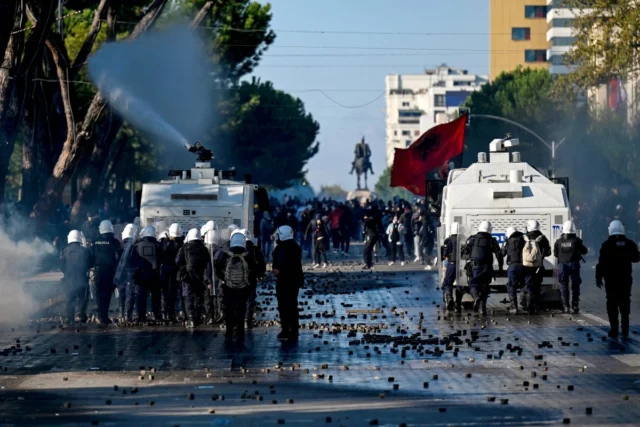
Outside, the sitting was received as its organisers had promised a week earlier. Protesters who have marched daily since early June demanding the resignation of Prime Minister Edi Rama gathered around the building with cartons of eggs and tomatoes. Report TV drone footage showed a double security perimeter, a metal fence backed by a line of officers, running from the Namazgjaja mosque to the Ministry of the Interior. Shqiptarja.com counted the crowd in the tens.
By the time MPs began to leave, the eggs were in the air. Several deputies’ cars were pelted. The vehicle carrying Socialist MP Ilva Gjuzi was blocked and struck with eggs and tomatoes before police cleared the road; Top Channel reported that one protester kicked the car and broke a mirror. A Rapid Intervention Force unit passing the crowd was hit and answered with “Polici e krimit” (Police of crime). Protesters also tried to knock down a drone flying above them. Police escorted the journalist Shpend Gashi and Adriatik Lapaj, leader of the Lëvizja Shqipëria Bëhet movement, after Lapaj intervened during the police action involving Gashi. Report TV’s later running account put the total number escorted at seven. The Rapid Intervention Force reinforced the “Shqiponja” units to disperse the crowd. Traffic from the Dëshmorët e Kombit boulevard into the inner ring stopped for some minutes. No injuries were reported by 20:00.
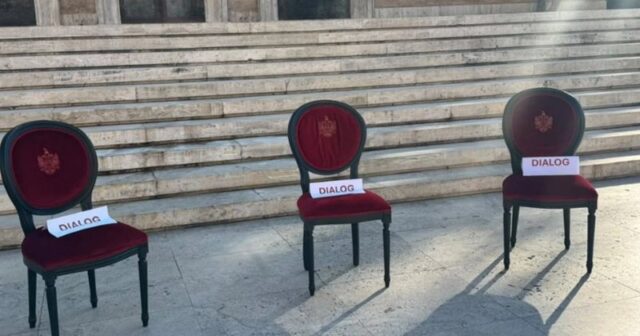
Inside the chamber, before the walkout, Tedi Blushi, chairman of the Freedom Party parliamentary group, called for Parliament to be dissolved, saying it no longer represented Albanians and that a metal fence had been placed between the people and the Assembly: “Kuvendi në shtetrrethim” (the Assembly under siege). In a written message marking the opening of the session, President Bajram Begaj had asked the majority to turn commitments into results and the opposition to provide oversight and an alternative, and had described the protesters’ energy as something that should feed dialogue.
The Toptani corridor
The confrontation that will outlast the eggs happened before the sitting began and away from the cordon.
Shortly after 16:00, Socialist MP Iris Luarasi walked through the Toptani shopping centre on her way to the Assembly. A group of protesters followed her through the mall. At the front was Arvina Lleshi, an activist our newsroom has recorded as a named speaker at the marches since at least day 99, when she and Ilir Xhemalaj set out the demand for a resignation and a technical government. Filmed on phones, Lleshi addressed Luarasi directly:
“Hajdute! Mos fol në emër të grave! Ti nuk je mbrojtësja e grave! Ti nuk i përfaqëson gratë! Po, ti! Po ti përfaqësoje nuk do të bashkoheshe me qeverinë e krimit! S’kemi turp fare, turp të keni ju! Hajdute!”
(Thief! Don’t speak in the name of women! You are not the defender of women! You don’t represent women! Yes, you! If you represented them you would not have joined the government of crime! We have no shame at all, shame on you! Thief!)
Luarasi was recorded replying “Sa turp” (how shameful) before walking on.
Her answer came at 20:03, on social media, and it is the fullest response to the protests that the Tirana Examiner has recorded in their first hundred days. We reproduce the passages that carry the argument.
“Sot duke hyrë në parlament disa vajza më kishin zënë pritë, me sharje, me fyerje dhe me celularët gati për të filmuar spektaklin që kishin përgatitur. Dhe patjetër që për një çast u lëndova, jo se nuk e përballoj kritikën, por sepse pashë vajza të reja që besonin se poshtërimi i një gruaje ishte mënyra për të mbrojtur gratë.”
(Today, entering parliament, some girls had set an ambush for me, with insults, with abuse, and with their phones ready to film the spectacle they had prepared. And of course for a moment I was hurt, not because I cannot take criticism, but because I saw young women who believed that humiliating a woman was the way to defend women.)
“Më akuzuan se nuk mbroj gratë ndërkohë që po dhunonin vetë verbalisht një grua. Kjo është vërtet ironike, por edhe për të ardhur keq! Mbrojtëse të grave, me fyerje në gojë, me telefonin në dorë dhe një grua të vetme që e kishin rrethuar.”
(They accused me of not defending women while they themselves were verbally abusing a woman. This is truly ironic, but also sad. Defenders of women, with insults in their mouths, phones in hand, and a single woman whom they had surrounded.)
“Unë nuk pretendoj të përfaqësoj këto gra që ngatërrojnë aktivizmin me agresionin, protestën me pritën dhe guximin me fyerjen. Por, përfaqësoj gra dhe vajza të tjera që punojnë dhe e ngrenë zërin me dinjitet.”
(I do not claim to represent these women who confuse activism with aggression, protest with ambush, and courage with insult. But I do represent other women and girls who work and raise their voices with dignity.)
She closed by saying she would report the incident to the authorities: “fyerja nuk është protestë, poshtërimi nuk është aktivizëm dhe dhuna nuk bëhet më pak dhunë vetëm sepse ushtrohet nga vajza” (insult is not protest, humiliation is not activism, and violence does not become less violent simply because it is carried out by girls).
At 19:16 Deputy Prime Minister Albana Koçiu had already placed the government’s weight behind her:
“Kjo nuk është as protestë, as shprehje e zemërimit qytetar. Është dhunë e mirëfilltë dhe e shëmtuar… Dhuna ndaj përfaqësuesve të institucioneve dhe deputetëve, veçanërisht ndaj grave, si në rastin e sotëm ndaj Iris Luarasit, është një akt i turpshëm. Aq më e rëndë bëhet kur nxitet nga vetë gratë. Sjellje të tilla nuk përfaqësojnë dhe nuk mund të përfaqësojnë Shqipërinë europiane.”
(This is neither protest nor an expression of civic anger. It is genuine and ugly violence… Violence against representatives of institutions and MPs, especially against women, as today against Iris Luarasi, is a shameful act. It becomes all the more serious when it is incited by women themselves. Such behaviour does not and cannot represent European Albania.)
Analysis: the first argument
For a hundred days the marches have spoken in slogans, and slogans do not require an answer. “Ju erdhi fundi” (Your end has come) can be chanted at the Prime Minister’s office, at Parliament, and, on day 99, at the United States Embassy, without anyone being obliged to say anything back. What happened in the Toptani corridor is different in kind. Lleshi made a claim with a subject and a predicate: a woman who joins this government forfeits the right to speak for women. Luarasi answered with a counter-claim: women who surround and film a lone woman forfeit the word “activism.” Each is a proposition about who may speak in the name of Albanian women. In our record of the protests, this is the first time since June that the street and a member of the majority have argued about the same thing.
Lleshi did not pick the target at random, and she did not pick an incidental feature of it. Before she entered Parliament, Luarasi spent nearly three decades on violence against women. She has led the Counselling Line for Women and Girls, the national helpline established in 1996, and has also led the Counselling Line for Men and Boys, Albania’s first centre working with perpetrators of domestic violence. She sat on GREVIO, the Council of Europe body that monitors the Istanbul Convention, from 2015 to 2023, was elected its third president in June 2021, and from February 2022 chaired for a year the global platform of expert mechanisms on violence against women. She is vice-chair of Parliament’s Committee on Human Rights and Public Media. When Lleshi said “mbrojtësja e grave” with a sneer, she was naming the exact foundation of Luarasi’s public authority and declaring it forfeit. “Hajdute” was among the generic accusations thrown at Socialist MPs on Tuesday; Luarasi additionally got “you don’t represent women.” A tactic, and a precise one.
The word is doing two jobs in the exchange, and only one of them is contested. Luarasi represents her constituents by election; nobody on the pavement disputed that. What Lleshi challenged is the second sense, whether Luarasi’s politics and alliances still let her credibly claim to advance women’s interests. That challenge is legitimate in a democracy. A record on the Istanbul Convention does not place a deputy’s votes beyond criticism, and a woman is entitled to oppose another woman’s politics as fiercely as any man is. The distinction Lleshi drew is the right one. The manner is the question.
Luarasi’s reply is precise in return. It takes a quality the protests have claimed as their own, the moral authority of young women in the street, and turns it into an exhibit against them. “Vajza të reja” appears in her text as a fact she is sorry about, not as an enemy. She concedes their youth and their sex entirely and then denies them the noun. She does not say they are wrong about the government. She says they are not activists.
Here the record has to be held apart from the language. What every account describes in the Toptani corridor is pursuit, crowding, accusation and filming. None describes physical contact. Luarasi called it verbal violence; Koçiu called it “dhunë e mirëfilltë.” Those are the speakers’ words, and they belong inside quotation marks. Gjuzi’s afternoon was a different thing: a car blocked, struck, unable to leave, and by Top Channel’s account kicked and damaged. One woman was surrounded in a mall; another was inside a vehicle a crowd stopped. Filing both under a single word, whether “violence” or “protest,” makes the day less legible, and a newsroom that wants to describe women in Albanian politics accurately has to be able to tell the two scenes apart without shrinking either.
And Luarasi’s cleanest sentence claims more than the facts give her. “Fyerja nuk është protestë” is a good line and a bad rule. Insult has been part of political protest for as long as there has been political protest; calling a deputy a thief is speech, however it lands. What separates Tuesday from ordinary abuse is not the vocabulary but the arrangement: a group, a single person, a corridor, phones raised. That arrangement is what her report to the authorities will have to describe, and it is a harder thing to describe than an insult.
Koçiu’s contribution is the one worth watching. “Aq më e rëndë bëhet kur nxitet nga vetë gratë” converts the sex of the confronters from a mitigating fact into an aggravating one. Read charitably, she is pointing at a contradiction: defenders of women humiliating a woman. Read as written, she has set a standard in which a woman owes another woman a civility no man is asked to observe. A government that has spent a decade arguing for women as full political actors cannot easily sustain that, because full political actors include opponents of one another. The line the state can defend is conduct, and conduct is sexless. The Deputy Prime Minister has handed the marches a target they did not have on Tuesday morning.
The other women of the day should be recorded, and the ledger does not run one way. The sitting outside which the protesters gathered elected a woman deputy speaker and confirmed a woman health minister. Both offices were already held by women; Tuesday moved women between senior posts, which is not the same as answering Lleshi. And the chamber itself supplied an example of how a female office-holder could be addressed in personal, patronising terms on the same afternoon that ministers were demanding a particular civility toward female MPs. Before the walkout, Democratic MP Flamur Noka told Spahiu to refuse the ministry, reminded her they had been schoolmates, warned that she could end up behind bars, and said she would sign the KAYO contracts “fap-fap, moj e gjorë” (in a flash, you poor thing). His argument was about corruption and legal exposure, not her sex. The register was something else, and the reader can hear it.
What we do not yet know is whether Lleshi’s line was hers or the movement’s. If it was an improvisation, Tuesday will be remembered for the eggs. If it was a decision, the marches have found a line of attack that reaches past Rama to the individual legitimacy of the deputies who keep him in office, and they have found it on the one subject where the government believes it holds the moral high ground. Luarasi says the incident will go to justice. The argument will not.