The Dutch embassy’s security and stability officer stood in the front row of the Tirana protests with a megaphone, co-published the movement’s calls and still wears its emblem. Three explanations cover the facts. None of them leaves The Hague’s reporting on Albania intact.
By Drizan Shala (Security Desk)
The Dutch foreign ministry watches the Western Balkans through a network built for the purpose: two regional coordinators, one for security seated in Sarajevo and one for stability seated in Skopje, and in each of its five embassies in the region, Sarajevo, Skopje, Tirana, Pristina and Belgrade, one local expert who feeds them. The ministry’s own vacancy text for the Skopje seat describes the work: to monitor, signal, advise and analyse developments that may affect the security and stability of the host country, on request and on the officer’s own initiative, under the guidance of the ambassador. The Pristina text adds the words that matter in a crisis: reporting and early warning.
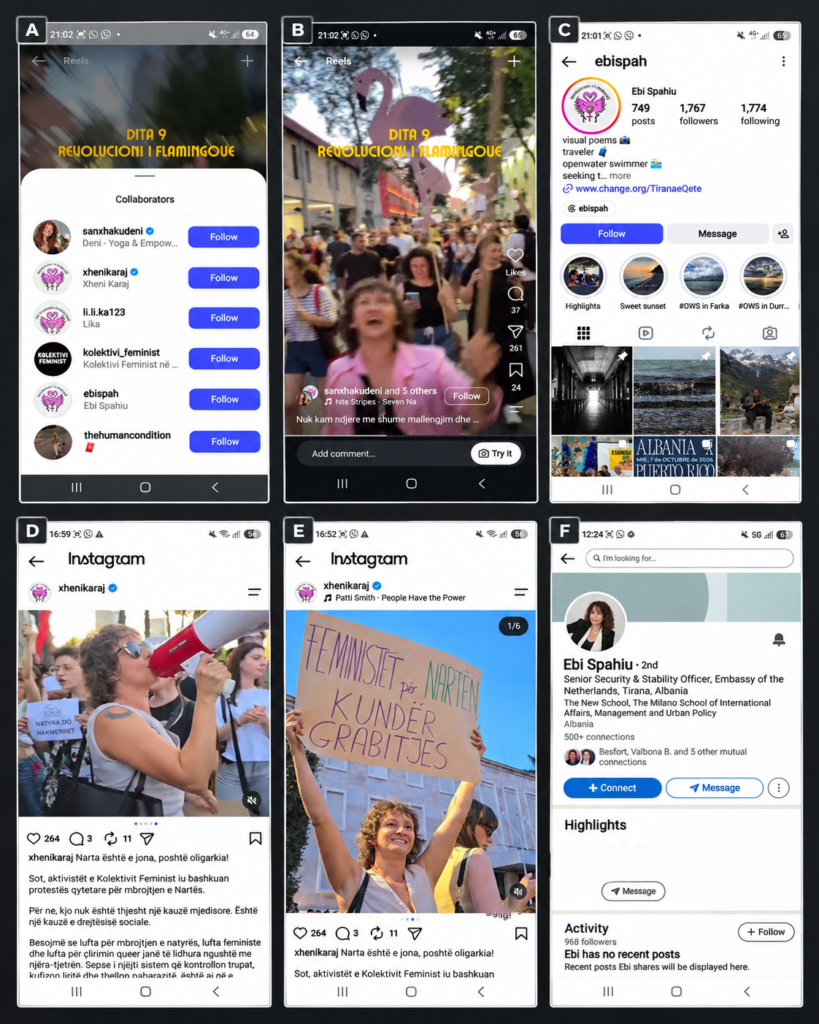
That is the seat whose holder in Tirana, Ebi Spahiu, Senior Security and Stability Officer by her own description, stood in front of the Prime Minister’s Office on the evening of Monday 1 June with a cardboard sign reading “Feminists for Narta, against the plunder” (Feministet për Nartën kundër grabitjes), and later that evening with a megaphone. Xheni Karaj posted the pictures and the video under the line “Narta is ours, down with the oligarchy” (Narta është e jona, poshtë oligarkia!). In another video from the protests she chants with the crowd: “Rama, resign” (Rama, jepe dorëheqjen). She held the seat on 1 June. She holds it today.
It was the second evening of the Tirana protests. Two days earlier the first confrontation in Zvërnec had left several protesters and a journalist injured and fifteen people facing criminal proceedings; Athens had issued a statement the day before. In a protest wave the first week of reporting is the week that sets the frame in the capital. Whether The Hague filed Zvërnec as a local property dispute, an environmental campaign or the opening of a political crisis was decided by what came out of the Tirana embassy in those days, and the person employed to write it was on the boulevard.
She did not step back afterwards. On 6 June her account co-published, as a listed author, Kolektivi Feminist’s call for a “Swim for Narta” with Eva Buzo. On 8 June it co-published the movement’s “Day 9” reel. Her profile picture is the movement’s emblem, the Flamingo Revolution (Revolucioni i Flamingove). It was there in June. It is there this week.
This publication does not say the embassy organised or steered any of what followed, and the record does not need it to. By 4 June the marches were demanding the government’s resignation. After 18 June twenty-seven people faced proceedings. In October the fires came and the health ministry counted 310 people treated, 191 of them police. For every one of those weeks the Dutch embassy’s stability reporting on Albania went up a chain that began at a desk whose occupant wore the movement’s brand in public.
What that does to the product can be stated without reading a single cable. An assessment is worth exactly the distance between its author and the thing assessed. Early warning written by a participant cannot be read as early warning, whatever it says, because the reader in The Hague has no way to separate the embassy’s judgment from the movement’s. The damage does not stop in Tirana. The seat feeds the coordinators in Skopje and Sarajevo, whose regional picture feeds the ministry, whose picture of Albania is what Dutch ministers carry to Brussels when the Council decides on Albania’s chapters. The Netherlands said on 26 May that member states had anchored their expectations “as prerequisites for concluding negotiations.” The embassy in Tirana is an input to how The Hague judges whether those prerequisites are met. For five months that input has had a participant at its source.
The ministry has controls built for exactly this case, and they work by notification. Local staff are employed by the State of the Netherlands under the Legal Status (Local Employees) Regulations 2020, which apply subject to local employment law and to a Tirana mission version the ministry has not published. Article 6.1 requires conduct befitting a good employee and awareness at all times of working at a representation of the Kingdom; the phrase covers a Monday evening as much as a Tuesday morning. Article 6.3 requires an employee to notify the employer of outside activity that could touch the interests of the service, and forbids it where the proper performance of the job cannot reasonably be ensured. Article 7.4 treats as dereliction anything a good employee in the same circumstances should refrain from doing, with penalties from a written reprimand to dismissal. The system assumes that the employee notifies or the head of mission sees. One of those two things either happened or did not.
The Hague applies the same test to its own officials. Article 10 of the Ambtenarenwet requires a civil servant to refrain from demonstrating where proper fulfilment of the function cannot reasonably be ensured, and the government told Parliament in 2024 that the closer the subject of the protest sits to the job, the sooner that line is crossed. There is no closer case than an officer whose job is to assess the protest she is in.
The reply that citizenship changes this is familiar to anyone who has worked inside an international service, and it is wrong in every one of them. The rule attaches to the post, never to the passport. The UN’s standards of conduct say that staff serving in their own country are to exercise special care, which is the opposite of an exemption. The Dutch regulation forbids the employer to distinguish between employees by nationality, and the only concession it makes to a non-Dutch employee is one sentence of the oath. An Albanian citizen in the Dutch stability seat keeps every right she had as an Albanian citizen. The embassy keeps none of its right to call her output an assessment.
This is an embassy that addresses the Albanian state in the imperative, on the day, by name. On 12 March, within hours of the parliamentary vote on Belinda Balluku’s immunity, it told Albanian politics what it “clearly expect[ed]” of the justice system and that Albanian politics “remains responsible” for the process. On 26 May Ambassador Reinout Vos called judicial independence and unhindered anti-corruption efforts “non-negotiable prerequisites” and closed with a commitment that the Netherlands “will continue to closely monitor further developments.” Six days later the officer employed to do the monitoring was in the developments with a megaphone. The register the embassy uses for the Albanian government, same-day and in public, it has not used once, in five months, on the conduct of its own stability officer. On the June protests this publication found no statement from the embassy at all. On the October violence, while the EU, the United States, Britain and the UN spoke within days, the embassy’s single text came on 31 October, co-signed with an NGO, recording reported violence against citizens, activists and journalists; the police do not appear in it. On 2 November the new ambassador, Marleen Monster, in post since 31 August, wrote about safeguarding the independence of justice institutions.
Tirana is a small capital and it reads foreign missions through their people. A senior embassy officer at a rally outside the Prime Minister’s Office is read, in the crowd and in the buildings facing it, as the embassy at the rally: her placard as the embassy’s position, her presence as its endorsement. The people a stability officer deals with, in the ministries, the police and the other missions, know who she is, and any service worth the name logs who stands where in a crowd outside the Prime Minister’s Office. When the EU ambassador walked through that crowd on 5 June, Report TV ran it as a headline. When the Dutch stability officer stood in it with a megaphone four days earlier, no outlet ran a line, and the reading in the square and in the ministries was the only one available: wherever she appears, the embassy appears. In five months the embassy has done nothing to tell anyone otherwise.
Three explanations cover the facts. In the first, the embassy endorsed its officer’s role; a mission that places its own security staff in a movement demanding the host government’s resignation is interfering in the internal affairs of the receiving state in the plain meaning of Article 41 of the Vienna Convention. In the second, the embassy knew and let it stand: deliberate ambiguity, a presence on the boulevard that can be disowned in the chancery. The Convention does not reach that road, and it does not need to. A receiving state is entitled to read a mission by what it tolerates, and a mission that lets its officer’s presence be read as its own for five months, and never once corrects the reading, has chosen to be read that way; in Tirana that is interference with deniability attached, and it is the explanation the record fits. If the embassy’s position is that it knew and judged this compatible with her employment, it should say so in public and explain how a participant holds the stability seat under its own Article 6.3. In the third, the embassy did not know. That is highly unlikely, since the evidence sat on her public profile for five months and the embassy’s security function is her; and if it is true it is the worst of the three, because the Dutch security and stability function in Tirana then failed to notice the public conduct of its own officer through a summer of protest and an autumn of fire, and the ministry’s early warning on Albania this year was written by a system that could not see its own desk.
None of the three leaves the reporting intact. The Hague said its embassy would closely monitor further developments. The question it now has to answer is who wrote the early warning, and from where.