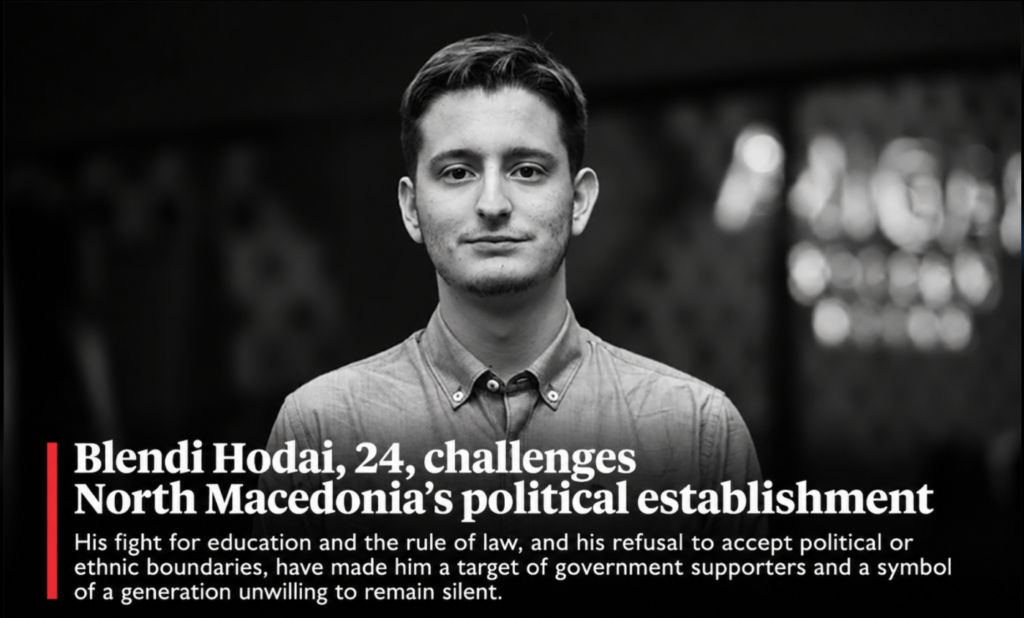
From the attacks on Blendi Hodai to his fight for student rights and institutional accountability: why ethnicity must not be the measure of who has the right to criticise, to demand change and to speak in the name of the public interest.
By Viktor Bučkovski (Skopje, North Macedonia)
“The palanka does not like the unknown; that is one of its basic traits, by which its history, its culture and its mental world are distinguished. But it rejects the unknown not only in its present, but also in time. It does not like it in the past, just as it does not like it in the future.”
Radomir Konstantinović, “The Philosophy of the Palanka” (Filosofija palanke). The palanka is the provincial small town and, for Konstantinović, the closed mind that goes with it.
Blendi Hodai bothers the palanka because in his fight it sees its own failure. It is in disbelief. Its mind cannot accept as relevant, sincere and real the fight of a twenty-four-year-old who dares to demand accountability and respect for the law from the “scholars” in power.
At 24, the Hodai phenomenon has a better CV than the entire government and opposition combined had at that age, and perhaps have even today. His reach and his work are local, but also global. He is known in Tetovo, in Skopje, in Ohrid and in Struga. In Strasbourg and in America. Prime Minister Hristijan Mickoski says of Blendi that he is rude and that he insults university professors. The foundation of former US President Barack Obama, for its part, chose him as one of 35 young European leaders in the Obama Leaders programme for 2026-2027.
Through his work at the Forum for Educational Change (FECH, known locally as FOP), Hodai is the chief opponent of every bad education policy, whether it comes from the thorny rose, the long arm or the double-headed bird. Blendi fights for what is the foundation of a civilised society: education, learning, opening eyes, widening horizons, changing the very genesis of what it means to be a Macedonian or an Albanian.
Everyone needs education, everywhere, regardless of ethnicity. An illiterate Macedonian, Albanian, Rom or Turk is, at the end of the day, an illiterate citizen of our common state. There is no “either-or” here. Illiteracy knows no ethnicity, and all of us feel its consequences.
Blendi was educated in schools in Macedonia and is a student at UKIM [Ss. Cyril and Methodius University in Skopje]. Loyal to the cause. There is something in his fight that the palanka can hardly bear. He does not ask permission to think, to criticise and to act. He does not accept the pre-assigned role of the young man who should obey, keep quiet and be grateful for what his elders have left him. Still less does he accept that his ethnicity should define the political space in which he is allowed to act.
And that is why these days Blendi is the main opposition to the government and the leader of the students, whether we accept it or not. Exposed to attacks from bot networks, to insults and to attempts to discredit him, he carries on with his fight. One young man, with a pencil in one hand and the law in the other, managed to unsettle the political elite and shake its sense of untouchability.
Let us see what Blendi is actually being attacked for.
- He filed a lawsuit with the Administrative Court over the Ministry of Education and Science’s failure to respect the law.
- He showed the Parliament’s menu, which IRL [Investigative Reporting Lab] revealed in its latest investigation into the subsidised student meal.
- He asked the professors in power, Hristijan Mickoski and Vesna Janevska, to prove that students are buying cigarettes, instead of trading in bazaar gossip. And even if they are buying them, so what?
THAT IS ALL.
None of this is contentious or insulting, unless you belong to a political structure that experiences every question as an attack on its own authority, and every criticism as a personal insult.
With this goal scored straight from the corner, Hodai drew every pro-government leech onto himself. For a whole week he has been attacked and insulted and, by the smarter ones, smeared and argued against. They discredit him first because he is an Albanian, which is nonsense; Albanians were, are and will be a constituent people of this state. The main argument they use to justify the Ministry’s failure to respect the law is: “In our day there was no student meal. Spoiled children, nothing is ever enough for you!” Like most arguments of the pro-government commentators, this one too is empty. By the same logic, students once had no internet, no laptops and no tablets, which, truth be told, this very government subsidised. Pensions were also half what they are now; by their logic, should we roll those back too? If something did not exist in the past, does that mean it should not exist today? And since when did the shortcomings of the past become an argument against improving the present?
The spirit of the palanka tries to preserve the established order. Anyone who steps out of the fixed pattern becomes a danger to its survival. And the one who shows by his own example that a different way of living, thinking and acting is possible becomes an even greater threat.
Through his actions Blendi shows the possibility of change. The possibility for a young person to be politically relevant without a party membership card, to be socially influential without a state post, and to be recognised beyond Macedonia’s borders without first receiving the blessing of the domestic political authorities.
So why not an Albanian?
Why should an Albanian not be the loudest opponent of bad education policies in Macedonia? Why should his fight not be our fight too? Why should we not recognise in his success the success of the whole society? The palanka wants to know in advance where everyone’s place is. Who belongs to whom, who speaks for whom, who has the right to ask questions and who should keep quiet. Blendi’s actions break those boundaries. That is why his fight is bigger than the question of the student meal, than one lawsuit, one press conference or one political polemic.
His fight is a fight that opens the possibility for Macedonia to step out of its own insularity and conservatism, the insularity of the palanka.